...Given the surprising claims that have been reproduced by numerous credible people in a variety of listening rooms with a variety of equipment, it won't do to keep arguing based on the old paradigm. The old paradigm must be at least partially wrong since it apparently can't predict the MS effect.......
Actually, having now viewed and listened to Hugh's "Master Set" setup, I don't think that is the case.
Hugh's setup now looks like this ...
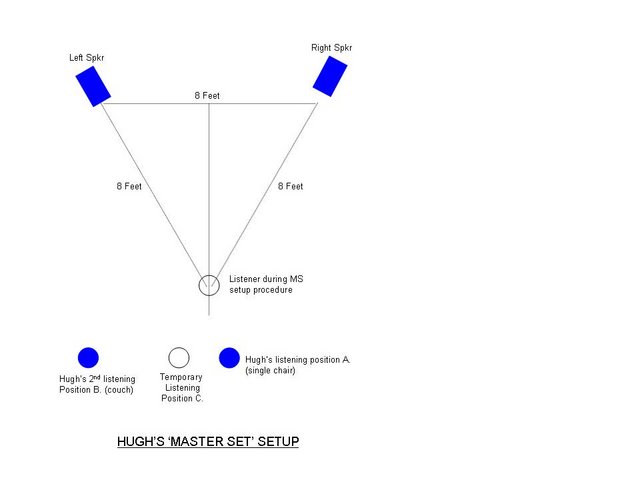
You can see that the right speaker is set slightly closer to the front wall than the left. This is where Steve and Hugh observed the most even bass response in the room during the MS procedure. I had not noticed any bass problems on my previous visits but that doesn't mean much and I'm not implying that there weren't any or that the bass isn't more even now than it was before. In my previous posts I stated that I could envisage how the MS setup could indeed lead to more even bass throughout a room, especially an asymmetrical one. For this reason alone I will still try MS in my room at some point.
However, the key point of my earlier posts was that the room's capacity/dimensions/materials/etc will only have a "pressurisation" effect on frequencies below approx 200Hz (causing peaks and nulls in this range), not those above it. However, room boundary "reflections" will have an affect on this higher frequency range. The longer paths to our ears off the walls (than the direct path from the speakers) causes "time smear" and is a form of distortion of the playback. This is why we use absorption and diffusion to treat the primary reflection areas and minimise the coherent reflections.
As the amplitude of one speaker rises in relation to the other, it starts to dominate the other speaker and this is why the vocalist/instrument sounds like it is coming from the loudest speaker (this was the reason for balance controls). When both speakers play a vocalist at the same amplitude, that vocalist will appear to be standing in the middle between the speakers (assuming that is where they stood during the recorded performance). This is one of the basics of how "stereo" works. When both speakers play the vocalist at the same amplitude, but one speaker is closer to you, the nearest speaker will have less energy loss due to the shorter path to your ears, and will thus sound louder. This causes the vocalist to move toward the nearest/loudest speaker. The only way I know of to offset this effect is to toe-in the speakers such that they cross in front of the listener. This means that as the listener moves toward the right speaker (thus hearing lower amplitude from the left speaker due to losses over the greater distance) he becomes more off-axis from the right speaker and more on-axis from the left speaker. You may have experimented with toe-in and found some speakers to sound too "hot" in the high frequencies when on-axis (ie. pointed at the listener) and needed to toe them out a little to reduce the energy. This is the same thing. We are moving more off-axis but to the other side of the axis. Therefore, the drop in energy from the nearest speaker (more off-axis) compensates for the higher amplitude caused by that speaker being closer to the listener. The end result is that the vocalist remains in the centre off the soundstage. This is why I was asking Steve whether he felt that this might be the reason that MS did not upset the imaging.
Crossing speakers in front of the listener has an additional benefit. The side walls become much more off-axis from the speakers and thus side wall reflections are greatly reduced in energy. This reduces the time smear distortive effect mentioned earlier and provides a sense of calmness or purity to the presentation. It helps focus the imaging and can enhance low level detail. Initially, this loss of energy from the side walls can be perceived as a lessening of the envelopment effect from the speakers, but as you listen further you become used to it and notice the benefits. For simplicity, I'm just talking about dynamic cone speakers here as dipolars and other speaker types have different radiation patterns etc. Bear in mind that although MS may require crossing the speakers, crossing the speakers does not require MS. Many people, including myself have had their speakers crossed in a standard symmetrical setup and observed the benefits I just described.
As soon as I walked into Hugh's room and saw the speakers crossed in front of the listener, I could see that I was right about how MS overcomes the amplitude/imaging problems caused by unequal distances from the listener to each speaker. This is what I was trying to coax from Steve. When I listened from the single chair (point A in the diagram) I immediately noticed the reduced sidewall reflections and the same improvements I have heard previously from crossing speakers. The imaging (at this seat) stayed fairly well central as a result, despite the seat being closer to the right speaker. Moving to listening position C, the lead vocal did tend to move toward the left speaker (just as it does in a typical non-crossed symmetrical speaker setup) though perhaps to a lesser degree. I did not listen from point B although Hugh indicated that he heard the vocalist closer to the centre than I did from point C.
To clarify, I agree with Steve that MS can help even out the bass around the room by avoiding positions where particular bass frequencies (under 200Hz) suffer peaks or nulls as a result of interaction with the room. However, the improved mids and highs are a result of crossing the speakers in front of the listening position rather than the actual speaker locations, and crossing the speakers is necessary to overcome the problems that would otherwise occur from an MS setup due to the speakers being at different distances from the listener.
So, if you acknowledge crossing the speakers as an MS concept (rather than something that can be done independently), then yes, I agree that MS can provide benefits in the bass, mids and highs!

