Robert,
Thanks for your thoughtful post. I too am not here to argue or create ill will although, sadly, that is often the result!

My intent is only to get to the truth of what matters and what does not.
> It is not isolation that we are providing it is resonance transfer based on the effects of Coulomb’s Friction. <
Okay, so how does that relate to an improvement in audio quality? What
specifically is affected when someone puts a set of your cones under their CD player? And by how much? Do your cones reduce distortion? Do they improve the frequency response? What exactly?
> We are a company consisting of degreed engineers and are willing to provide you any information, other than proprietary, that you wish. <
Great. As degreed engineers you should be able to explain exactly what audio parameters are affected by putting cones under a preamp, and by how much.
> Paying an outside laboratory a lot of money <
Okay, so lets start with the results of any tests you've performed yourself. All the degreed engineers I know own, or have access to, oscilloscopes, distortion analyzers, and so forth. My company uses IBM's lab to formally test our products, but we also do a lot of testing in-house. Several of those tests are documented on our web site, showing room resonance and low frequency response before and after adding our bass traps.
> I have noticed on your website that your partner is a bass guitar player. We are willing to provide him a few Sistrum Platforms for under his guitar amplifier. <
I readily accept that putting an isolation pad under a loudspeaker can affect the sound. I think I made that clear in the first page of this thread. What I question is the value of putting cones under solid state electronic devices.
> Expanding on the results of the ‘numbers game’ and all the information provided on absorption, when or how does one know when there is too much material placed into their environment? <
The benefits of our products are very easy to demonstrate. Not just audibly, but also with measurements. This graph is a perfect example:
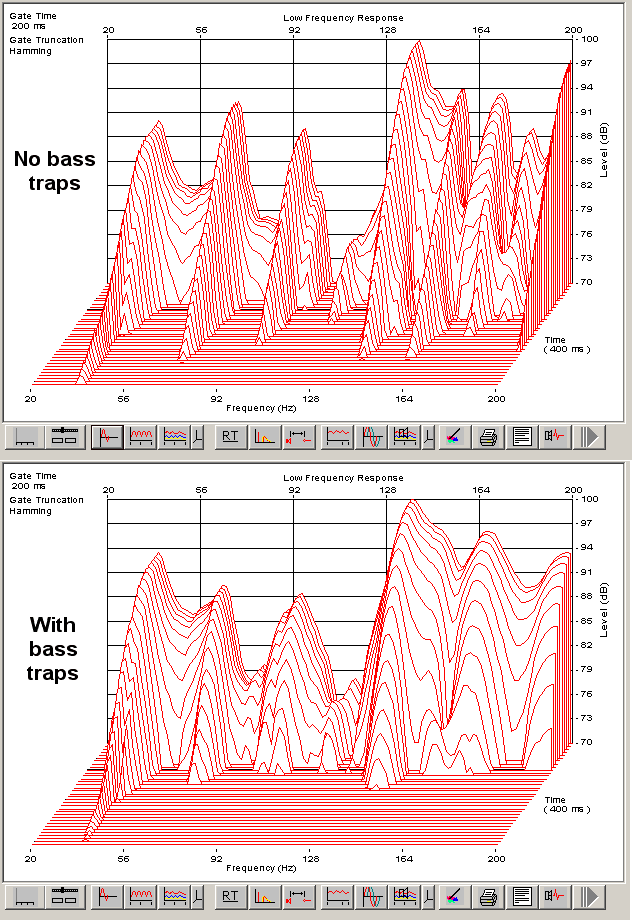
Besides being able to hear a blatantly obvious improvement in low end clarity after adding traps, you can also see that the response has been flattened considerably, the modal ringing is greatly reduced, and the modal peak bandwidths are also made much wider. All three of these translate into an obvious audible improvement. There is no disparity between what is measured and what is heard, and
both are very apparent.
As for how much treatment is too much, that too is well understood and mostly agreed upon. At low frequencies - below about 300 Hz - I don't think it's possible to have too much absorption. At higher frequencies we use a target RT60 (reverb time) in third octave bands to know when there's enough absorption. This can be fine tuned to taste and, again, there is no disparity between what is measured and what is heard. That is, after adding a few more panels you can see the RT60 has gone down, and also hear the change.
> The results of these testing parameters set forth by the Acoustics’ Industry does not inform a listener as to how your products will establish a more natural ring to the ride cymbal or how the decay time from said cymbal will be affected <
Bass traps don't do much for cymbal ring. However, mid/high frequency absorption placed at the first reflection points definitely improves clarity. Of course, that won't affect cymbal ring either because a cymbal decays based on its own properties, not the properties of the listening room when played through loudspeakers after the fact. Discounting excess ambience in the room which is a separate issue.
Again, the improvement from acoustic treatment can be measured
and heard. When treating the first reflection points, one measured improvement is avoiding comb filtering, which of course affects frequency response. The other improvement is the reduction of individual echoes, which also improves clarity. So your implication that the benefits of adding acoustic treatment cannot be assessed "scientifically" is incorrect.
> how these materials will add control to the pace, rhythm and time <
Wow, you actually said "pace." I would love to know what that means.

Like a cymbal's decay, rhythm and time are functions of the musicians and their instruments. Not the playback devices.
> Are your products capable of providing an audible breath prior to hearing the voice from the microphone? <
Say what?
> how will your products affect the overall musical performance within any unique listening environment? A chart or research documentation can not answer any of these questions <
Easy: Acoustic treatment improves clarity at low frequencies by damping room resonances, as well as the other things I mentioned above. This absolutely can be documented, and measured, and heard. See the above graphs for proof.
> If you employ a Sistrum Platform beneath your amplifier and it does not survive a double blind test <
I'll save you the shipping cost. Just tell me what is improved and by how much. But please don't use words like pace and rhythm.

I'd rather hear something like "Using the standard 19/20 KHz frequencies, IM distortion is reduced from 0.01 percent to half that for our in-house test amplifier, and the improvement is due to [whatever]."
--Ethan

