hi
found some nice photoos of what i consider as
one of the masters of present audio development:

"For his own use, Salabert uses stripped-down electronics in wooden casings where capacitors are denuded and as many synthetics removed as practically feasible. While of modest origins, these modifications rather elevate the gear's performance beyond original sales costs."
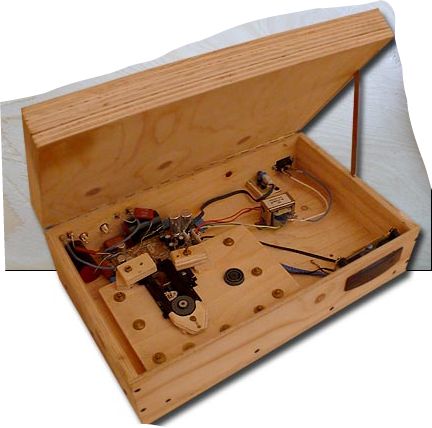
Bernard's CD player in a box
Bernard Salabert is designer and producer of PHY speakers
http://www.phy-hp.com/English/Products/Products.htmli was reading a bit an review and stumbled on this:
".... All we had to do was unscrew the bottom plates and take out two jumpers per amplifier. That remedied the auto reset protection. Ten minutes later, the amps were playing upside down
without bottoms for easy access just in case. Gone was the problem but there was something else. The sound has changed into a just slightly rounder version of the sound before the miniature surgery. We closed up the aluminum boxes again and proceeded to listen. Again something had changed. The roundness was gone again. A little gentle bite was reintroduced, acoustic guitars seemed to be played with a harder nail or pic, violins bowed more on the bow's edge.
Was it the amplifier's chassis? We removed the bottom plate again. Back was that roundness. In the end, we left a few screws out from the bottom and got what to our ears was the best sound.
Is it the enclosure that has so much influence?
It must be. Other Class D amplifiers we heard had some zing in their sound, a metallic edge. Few sounded different in a positive way, most notably the Red Dragon Leviathan. Is it the latter's wooden chassis that exerts such a positive influence? Now that we thought about it, the big brother of the MP150, the MP350, does have a lot of wood covering its electronic innards. An interesting test would be to wrap a Trends Audio Class D miniature amp in wood."
fromhttp://6moons.com/audioreviews/kharma2/matrix.html
photoos from
http://6moons.com/industryfeatures/phy/phy.html
