Noah & Friends,
A picture is worth a thousand words, they say. Well, I guess we’ll see how many these will generate. I believe my original postings on the subject of dispersion, its importance and the unnecessary compromise involved in achieving true Constant Directivity performance at narrower angles may not have been understood as clearly as I would have hoped. The following should clear things up - even if the title has you a bit puzzled.

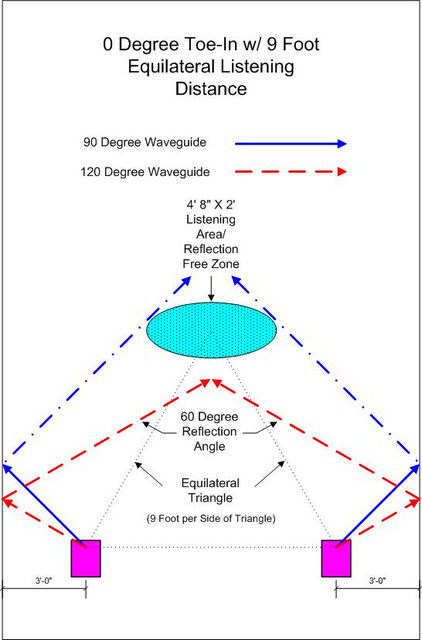
In this first graphic we have a pair of speakers in a 15’ W X 23’ D room. Each speaker’s center is 3 feet from the nearest sidewall. The distance from the wall behind them is not important in this discussion, so I haven’t exactly specified. That distance would certainly make a difference in the bass performance, but it has no bearing on the output of the waveguide – which is the subject of concern here.
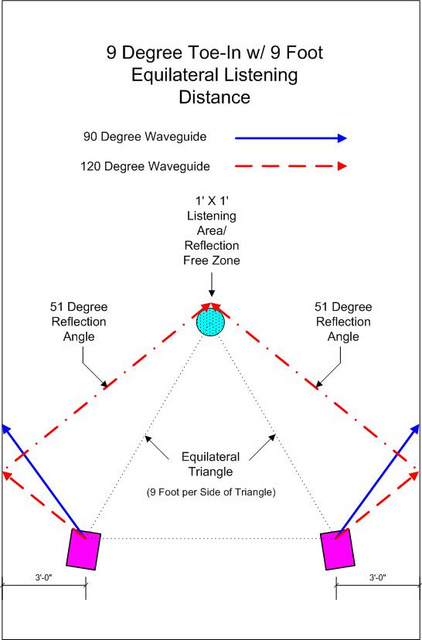
To help you interpret the following graphics, just remember that if a reflection “ray” crosses in front of the listening position – that’s bad. If it crosses behind – that’s good. The rest should be self-explanatory.
This first graphic shows us the advantage of true CD performance combined with a 90 degree waveguide. When the speakers are not toed-in at all, the CD waveguide of 90 degrees gives us the desired “Reflection Free Zone.” Of the two waveguides demonstrated here, it offers a widest possible listening area for a given placement distance from the sidewalls. Many may say, “Well, that settles it. That’s what I want.” To be honest, we would too if the tradeoff wasn’t the excessive time domain errors that result from having to use such a deep waveguide to obtain these results. I guess if your only concern is theater or sound reinforcement performance, then this is the way to go. If you have any high-resolution audio requirements though, you may want to think twice...maybe three times even.

The second graphic shows what happens when we move our listening area forward just a little bit. In this case, we’re looking at a normal Equilateral seating position as is commonly used in 2 channel stereo applications. We can see that the 120-degree CD waveguide is getting closer to achieving the reflection free zone that we desire. Still, further improvements could be had and are needed for optimal results.
The third graphic is now showing us what happens when we use a relatively moderate 9 degrees of toe-in. The Equilateral seating position is necessary to achieve the Reflection Free Zone that we desire. As we can see, the 120-degree waveguide is able to provide the necessary conditions, but seating is quite restrictive. This may be acceptable for many that prefer an individualized sweet spot, but an even wider listening area is possible, as we shall see.
The fourth and final graphic shows us what happens when we increase the speaker toe-in to 13.5 degrees. Up to 15 degrees is actually the preferable amount for most speakers, as virtually all traditional dome tweeters begin to narrow their radiation pattern to an approximately +/- 15 degree pattern above 10 kHz.

As we can see from this last graphic, the Reflection free Zone is quite wide and the listening distance is a bit further back besides. One can deduce from this that using the Equilateral seating position will widen the listening area even further. W
We would add to this the fact that even further improvements can be had by moving the speakers further from the sidewalls. As you may be able to tell, with a slight amount of toe-in, an additionally small amount of speaker inset from the sidewalls can have a considerable effect in widening the Reflection Free Zone. it will probably make the bass better too. In the end, everyone's room is somewhat different so your milage may vary. Nevertheless, it becomes easy to see that small adjustments in placement and toe-in can have fairly profound effects.
Closing on our original point, in all of the above we can clearly see that in most practical applications, the shallower, 120-degree waveguide can easily provide the desired Reflection Free Zone. It may take a few minor adjustments in positioning, but these adjustments will most likely be made for other reasons anyway. In so doing, it also permits the level of acoustic center time alignment with the woofer that we all prefer for true high fidelity reproduction. While the 120-degree waveguide is a bit of a compromise from a dispersion perspective, we at SP Technology believe it offers the best balance of performance features and compromise. Remember: Good engineering always dictates some level of compromise.

Oh...and before somebody jumps on the bandwagon and says, "But I thought your speakers sound better with very little toe-in," I have this to say: While that may be your preference, I actually doubt if that's optimal. Decreasing toe-in will have the effect of generating a bit more reflection from the sidewalls. This will be especially true near the lower end of the waveguide's operating range. Reflections from the sidewalls in the 900 to 5kHz band can have the effect of widening the soundstage and producing more of a 3-D effect.
It is for this reason many prefer the sound of dipoles or other designs that intentionally bounce sound off the rear and/or side walls. The image of a pair of Bose (yuk) 901's comes to mind. Isn't that what they were known for? Many folks like this effect but to be honest - it's artificial. In so doing, one tends to be creating their own form of "holographic synthesis." In the end there is no "right" or "wrong." Whatever suits your tastes is fine. Just be aware of the fact that this effect may not actually be in the recording. So toe those darn speakers in!
Hope this helped. It better... 'cause I'm pooped!

-Bob

