Wow, thank you, Charlie!
I've been meaning to do a thread like this, always seemed like something else needed to be done first, so thank you for getting it started.
I have two series of bass cabs: The Thunderchild series, and the Hathor series. The Thunderchild cabs are of the more hi-fi variety, some have said "studio-monitor like", and are more readily adaptable to a wide range of musical instruments (just about everything other than electric guitar, which usually calls for speakers with particular characteristics that are not compatible with reproducing bass energy at high volume).
Most of my cabs are designed with the first overtone of low-B, 62 Hz, very much in mind. Being able to deliver the first overtone of low-B at approximately full power (down no more than 4 dB) is, in my mind, sort of a required threshold for a high-end bass cab.
The original Thunderchild series is now in its Version 2 incarnation, wherein the original rectangular horn has been replaced with a square "baby butt cheeks" style horn (and crossover tweaked accordingly). This gives better dispersion in the vertical plane for situations where you're very close to the cab on a tight stage.
Let's take a look at the current Thunderchild series:
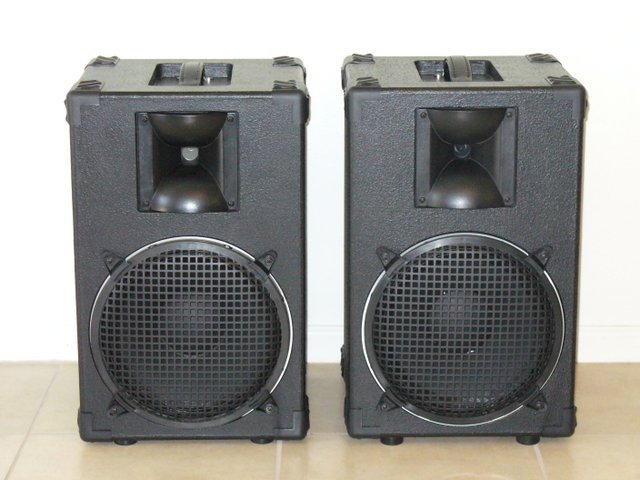
Thunderchild 112, available in 4 or 8 ohms. Dimensions 22" tall by 14" wide by 14" deep; 30 pounds; 95 dB in 4 ohms and 94 dB in 8 ohms; -3 dB in the upper 50's in 4 ohms, and -3 dB in the lower 50's in 8 ohms, 500 watts. The Thunderchild 112 in 4 ohms was my first bass cab, and is what put me on the map (well, on some maps anyway). $800 + shipping. The one on the left is a 4-ohm cab, and the one on the right is an 8-ohm cab (I can tell by the color of the bugscreen on the compression drivers):
* * * *
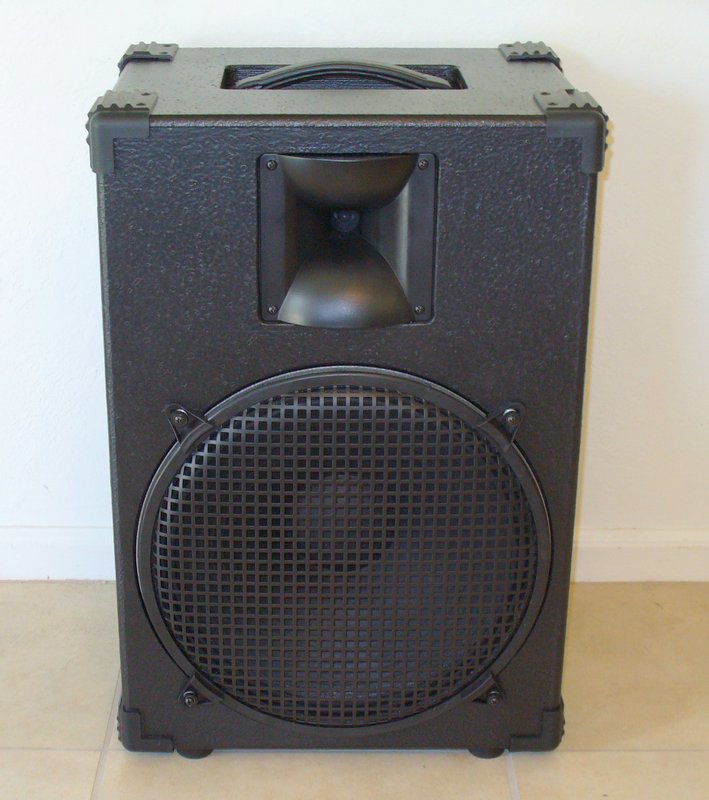
Thunderchild 115, now in its third version, is switchable between 4 and 8 ohms, and uses the custom Kappalte-based woofer developed for the Hathor 1505 (see below). As a result, this is the first Thunderchild cab that has a usable "growly" mode. Dimensions 25" tall by 17" wide by 15" deep; 38 pounds; 98 dB; -3.5 at 62 Hz (the first overtone of low-B); 500 watts. This cab and the Thunderchild 112 are being used for home audio by some of my customers, among other roles that are unorthodox for a bass cab. $1000 + shipping:
* * * *
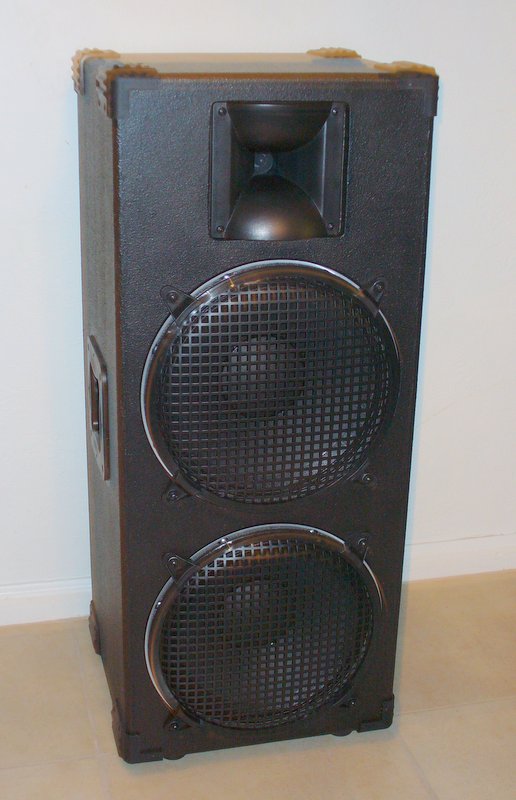
Thunderchild 212, 4 ohms. Dimensions 34.5" tall by 14.5" wide by 14.5" deep; 47 pounds; 97 dB; -3 dB in the mid-50's; 900 watts. This cab offers a lot of sound in a fairly compact footprint, and some have said that it's my best bass cab. It's also currently tied for most expensive, at $1200 + shipping:
* * * *
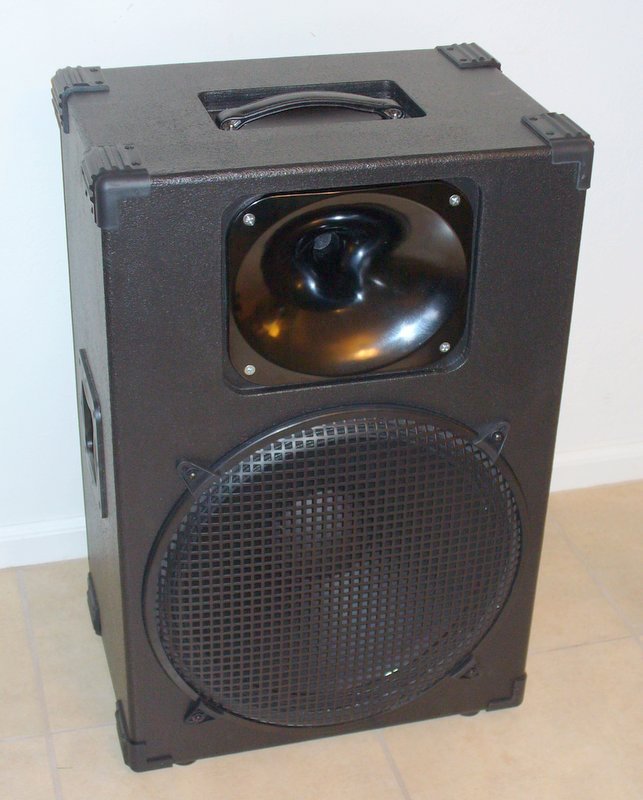
Thunderchild 118, 8 ohms. Dimensions 30" tall by 20" wide by 15" deep; 43 pounds; 97 dB: -3 dB in the upper 40's; 600 watts. This is a relatively new cab, which distinguished itself in Seattle a little over a week ago by
winning over a bass player and his wife, who plays electric violin. Not bad for a two-way with an 18" woofer! Introductory price is $1000 + shipping, so it's serious competition for the Thunderchild 115:
* * * *
Any of the Thunderchild cabs can be fitted with the rear-firing "acoustic friendly" tweeter for another hundred bucks. This tweeter is covering the same part of the spectrum as the front-firing horn, but at a lower SPL. This is mainly useful if you're going to be amplifying acoustic instruments like upright bass or cello or violin, or if you're going to be standing behind the cab for some reason (it helps you hear the overtones), or for your drummer (so that he has a better chance of being able to tell what note you're playing). Here's a shot of one of these rear-firing tweeters, on the right:
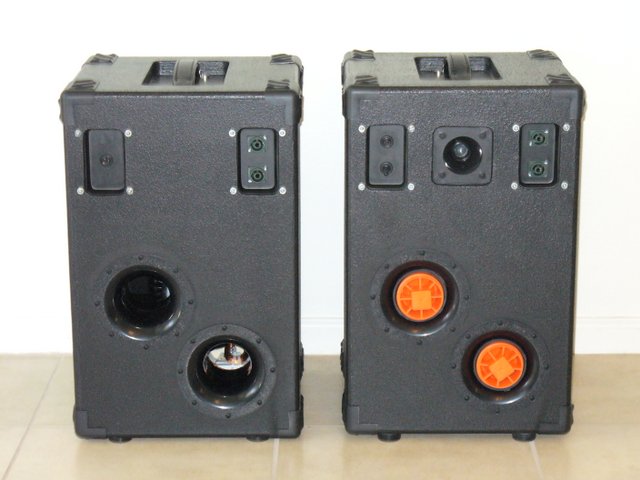
This is the backside of the two Thunderchilds 112 you saw above. The 8-ohm one has the rear-firing tweeter. It also has two switches instead of just one; both cabs have a top-end rolloff switch that rolls off the top end of the compression driver north of 3.5 kHz or so (all of my Thunderchild cabs have this switch), but the 8-ohm cab has a second switch that toggles between smooth and just a little growly in the upper mids. The TC115 and 212 also have this midrange smoothy/growly switch, but the 118 does not.
And last but not least you see both ports plugged in the 8 ohm cab. Let me tell you a bit about method and the madnesss to my porting:
I use flared ports by Precision Ports, and the flares help to delay the onset of chuffing relative to other port shapes. The ports are positioned right smack behind the woofer cone, so that midrange energy escapes through the ports. Imo this is desirable with the flares, as a second benefit of the flares is low coloration of the midrange energy that comes through them. In the acoustic friendly versions, this output combines with the tweeter's output to give you essentially fullrange energy behind the cab, albeit at reduced level compared with what's happening out in front of the cab.
The ports are positioned symmetrically behind the woofer cone, so that the cone doesn't see an asymmetrical airload. With long-voice-coil woofers in small boxes, an asymmetrical airload can result in enough cone-rock to cause the voice coil to click against the sides of the magnetic gap, which is a distraction we can do without.
Notice that one port is higher than the woofer magnet, and one port lower. This facilitates a bit of chimney-effect cooling, as hot air exits the top port, drawing cool air into the bottom port. The idea is to delay the heating of the magnet, as hot magnets lose strength (temporarily), and you don't want the cab to come up short on SPL for the last song of the set. The reason the ports are on a diagonal is packaging; not enough room to align them vertically - the inside of that cab is pretty busy.
My 115 and 118 cabs have four ports in a square behind the cone, and my 212 has three ports in a vertical line. In any of my Thunderchild cabs you can plug some or all of the ports and tighten up the low end accordingly, which can be useful for that once-a-year gig in that superboomy room. Or if you want to crank in some aggressive low-end EQ, the ability to choose different tuning frequencies can come in handy. I recommend port-plugging geometries that maintain a symmetrical airload as much as possible, so if we're going to plug two of the four ports on a 115 or 118, do it on a diagonal.
My wattage claims are both thermal and mechanical, and I use high-quality long-excursion woofers from Eminence and Faital, but my cabs can theoretically still be farted out by excessive low-end boost. My efficiency claims are calculated from the woofer's T/S parameters, and my -3 dB claims are based on modeling software. My weight claims are rounded up to the nearest pound. My dimension claims make allowance for the pooch-outness of the grilles.
I work just as hard on the crossovers of the Thunderchild cabs as on my home audio speakers, but I do give higher priority to power handling and total parts cost because those are more important considerations for the musical instrument cab market.
My Thunderchild series cabs are imo legitimately multi-role cabs, or light-duty PA cabs with enough excursion for bass guitar. But I really haven't tried campaigning them in other markets. At some point in the not-too-distant future, a pair of TC118s may be moonlighting as keyboard cabs for an electronica project.

