Roger...
Thanks for the videos. I started a thread "How Do Vacuum Tubes Work?" a month ago to try to gain a better understanding of the circuit. Wish I had waited!
A few other questions...
1) Is this a good illustration of the relationship between the input voltage, the grid voltage, and the voltage output the plate? I think the 150 should really be +150.
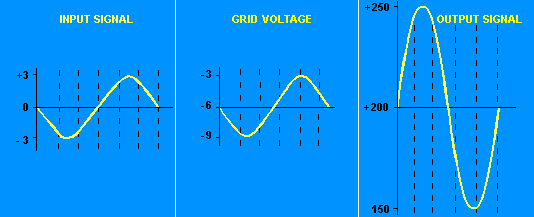
2) The coupling cap can be very small because the load after it is very high? I'm used to crossovers, in which case the driver is the load, and an 8 ohm load with a 1uf cap would only send frequencies above ~ 13k Hz to the driver. With the load on your drawing, everything above 4 or 5 hz will pass.
3) The voltage drop measured from the "bottom" of the cathode resistor to the "top" of the cathode resistor equals the grid bias?
4) What, if anything, happens during "tube break in"? Seems like the only thing would be the getter finishing the gas removal and from that point forward maintaining the vacuum.
Thanks again for the "class".
Mike
Hi Mike,
Good questions, here are answers.
1. Yes that and all the DC voltages are positive. However on the other side of the coupling capacitor the sine wave is centered around zero and that voltage will have equal positive and negative values. Non-sine audio will be averaged around zero having equal area over time positive and negative.
2. Yes the cap is small because the load is high, typically 100K to 1 Meg ohm to the next stage. However if this stage goes to the outside world the cap may be several microfarads as the outside load may be 10 K ohms or less. Several preamps that John Atkinson has tested have failed in this rather badly and have no bass into some typical modern power amp inputs.
3. Yes the voltage drop across the cathode resistor becomes the grid bias as the grid is held to zero by its resistor to ground and the cathode becomes positive making the difference negative as the grid sees it looking at the cathode. Its a very clever thing.
4. Break-in of audio gear has become the biggest crazy thing I have seen in recent years. The reviewers talk about it, manufactures now rate it in their specs..(I dont) and other than a few specific things like speaker suspensions I can give little scientific support to the concept. As to tubes, there is an aging process that goes on after the tube leaves the factory. The cathode emission will increase over time and this depends on how well the tube was aged at the factory. Given that electricity has gotten rather expensive the factories are aging less than in the good old days. Some batches of tubes I get are more aged than others, it's inconsistent. Power tubes show the most change over time going up as much as 20% in cathode current from the time I tube an amp till it burns in here for 24 hours. It may go up another 10% over the next 100 hours and then stay there for the next 1000 hours. Eventually the current goes down as the cathode ages further and I get about 10,000 hours out of my power tubes through careful choice of operating parameters.
I offer another aspect to the break-in phenomenon. What is the
break in time for the listener to get used to the new piece of equipment in his system?
As to the gettering, it doesn't influence the sound in any way and just keeps doing its job trapping off-gassing till it is expended. Then the tube does become gassy and is now susceptible to run-away current, red plates and melt down.

