Hi all, thanks to a little help from a friend in Connecticut, I've been able to spend a few hours with an Audeze Edition headphone setup (used last week for a show in Charlotte).
But short of IEMs on an iPod, my listening is nearly 100% 2ch. So while I had a chance to try out a number of things, the feature I feel most compelled to share is the Isabellina Pro DAC from my 2ch system. Pro is a fairly recent addition for RWA, and is also available as an upgrade for existing Isabellina DACs. Pro differs from RWA's original in that it is two DAC chips on the same board, allowing you to switch between NOS and hi-rez.
My comparison is limited to Redbook CDs (ripped to lossless digital on Macbook), as I do not have any hi-res files.
I was Vinnie's first customer for both the HPA (which contains an Isabellina DAC) and new Sig 15 integrated amp, so I am very familiar with his NOS DAC. My experience with RWA dates back to the original Signature 30. And I've owned every variation of that amp over the years, thanks to RWA's upgrade policy.
Thanks to a well treated room (GIK bass traps / side panels), near field listening, and the fantastic sounding Omega Super 6 Monitors / Deep Hemp sub (Monitors are single drivers, alnico magnets and hemp cones, in a beautiful enclosure) -- I honestly believe very few people hear more
realistic sound than I, and for those who do, likely 98+ percent have considerably more money in there gear. [Notice I use the word realistic. Better is subjective based on taste. But using real unamplified vocals and acoustic instruments as the reference, IMO sounding real is easier to judge.]
I am also fortune to play drums in several bands, including a new Diana Krall wannabe cover band, so I hear acoustic instruments on a frequent basis.
I say this only to point out, that of ALL the systems I've heard over the years, very few sound more natural or real then what I own. I've never heard Liliana's, so I know there is better, but hey, now you're back to RWA.
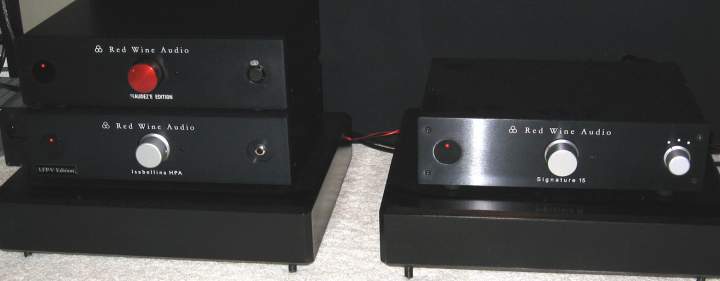 Isabellina Pro DAC
Let me begin by saying this is not an in depth review, and my listening is confined to 4-5 hours over a few days.
For starters the hi-rez chip has slightly higher voltage (compared to NOS), so while switching between DACs is a simple flick of a switch, proper comparison requires a slight bump up or down in volume to level the playing field.
My first impression was and still is, hi-rez is more
impressive. Everything is a little more etched compared to NOS, and it the overall sound presentation is more assertive (in your face), where NOS is more polite and laid back. Before I go much further, please note that impressive in itself is not necessarily better. But if you had 30 seconds to impress a friend (at least with my system), go hi-rez.
I also found hi-rez was able to extract more detail from some recordings. This is a case where many recordings may not have sounded much different, but put on well recorded brushes "stirring the pot" on a snare drum, and hi-rez can step to the front. Hearing Jeff Hamilton on D. Krall's live in Paris, is as close as I've ever heard to live brushes. The amount of texture I hear as the brush is slowly drawn across a textured snare head is absolutely uncanny. Switching back to NOS is wonderful, but there is some lost of detail.
I also felt there were recordings where hi-rez gave me the impression highs were more extended and in many cases the room had a touch more air (like the room became larger via hi-rez).
So where does that leave NOS? IMO Vinnie's original implementation is the king of tone and timbre. Short of vinyl, nothing I've heard does as well of capturing the realistic sound of a piano, flute, guitar, or human voice, etc. It also is very easy to listen to for long periods of time. And I also LOVE what NOS does with the image. Piano or small instrumental / vocal works in my room, feel like I can reach out and touch the musicians. This applies both side to side, and front to back. The image is very impressive. It's the kind of thing where the more I can relax and put myself in the performance, the more I appreciate the NOS DAC. And because the hi-rez is more assertive, my feelings about the NOS DAC would likely hold true over time.
So what does this mean, in this case for RedBook?
It is possible there will be people who's system or musical taste point them squarely at one DAC or the other. But many will likely find the ability to change the sonic character of their system for different recordings and various genres a welcome addition, and worth the $500 upgrade.
Cheers.

