The small-room-friendly project I've mentioned elsewhere is now ready to be unveiled. But my marketing department wants me to be sure and preface the unveiling by pointing out that the new AudioKinesis Rhythm Prisms actually DEFY THE LAWS OF PHYSICS! (<- note impressive use of the caps-lock key) That's right folks, they do the physically impossible: They cram a 12" wide woofer onto the front baffle of a speaker that's only 11 inches wide!
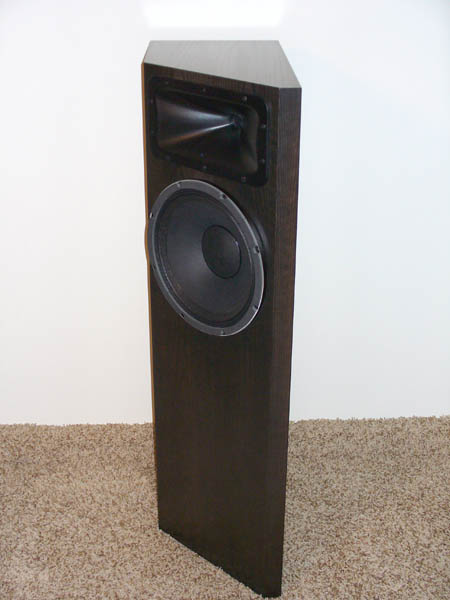
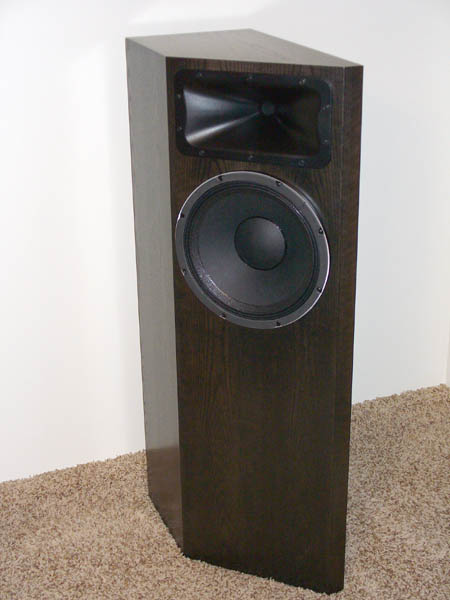
The left channel speaker is the mirror-image of this one.
Their secret, of course, is that the angled front baffle is actually 13.5 inches across, so the 12" woofer (frame size = 12.3") fits easily as long as I don't try to flush-mount it.
The reason for the unorthodox geometry is this: It allows the use of a large prosound woofer along with my recommended 45 degrees of toe-in without imposing an unduly wide footprint. In constast, when toed in 45 degrees the Jazz Modules have a footprint a little over twice as wide.
The Rhythm Prisms have the following unusual features:
a) Very good radiation pattern control (90 degrees in the horizontal plane from about 1.4 kHz on up), especially for a speaker only 11 inches wide. The built-in toe-in avoids a strong early sidewall reflection and gives an unusually wide sweet spot (which I can explain if you'd like), and the relatively narrow vertical pattern of the waveguide horn (50 degrees) reduces the amount of early floor and ceiling bounce energy. All of this works in favor of minimizing the undesirable very early reflections in a small room.
b) Placement close to a wall, and even in a corner, is feasible. A key factor here is the adjustability of the bass tuning system. On the back of the enclosure are two ports, one at the top and one at the bottom. These ports are offset to the inside, as the woofer cone is offset slightly to the outside. When the speaker is placed close to room boundaries you seal off one of the ports because both of them would tune the enclosure too high. This lowered tuning avoids bass boom and instead turns that boundary reinforcement into bass extension. Embracing the principle of spreading out the low frequency sources in the room as much as is practical for the sake of smoothness, you can seal the lower port on one speaker and the upper port on the other. Now there's significant staggering of your bass sources from the two speakers in all three dimensions.
c) On the rear of the speaker is a single external resistor in a terminal cup, and this resistor acts as a tilt control for the compression driver. It is bypassing a certain resistor in the crossover. By changing the value of this resistor, the compression driver's output can be tilted up or down, which does a better job of adjusting for room acoustic conditions than an L-pad's shelving characteristic, and this single external resistor is much higher quality than all but very expensive custom L-pads.
d) The drivers are high quality prosound units that have negligible thermal or mechanical compression in normal home use. This preserves dynamic contrast, and thus preserves the emotion in the music because musicians often use dynamic contrast to convey emotion.
The Rhythm Prisms can easily be used in a medium or large room, and/or out away from the walls, in which case we'd leave both of the ports open. The port lengths are also somewhat user-adjustable, allowing for further tailoring to a specific acoustic environment. In a very large room, they would probably need subwoofer augmentation.
These are the speakers that, in prototype form, were judged in an informal blind listening test to be competitive with the more expensive Jazz Modules. These are the speakers that killed my bipolar fullrange driver project, as for a few hundred dollars more the Rhythm Prisms offered a very significant improvement.
One of the main goals of this project was to keep costs down, which meant that I didn't have the luxury of using bigbuck drivers that are easy to work with. Instead I chose drivers that do what I want in the areas of dynamics and radiation pattern, and then designed a crossover that gets them to do what I want in the frequency response domain. This required me to develop some new techniques (new to me anyway) in order to get satisfactory correlation between my measurements and what I was hearing. I think I have preserved the dynamic capability of the drivers while achieving very competitive clarity and smoothness. My marketing department still thinks I've defied the laws of physics (and I hate to burst their bubble).
Specifications:
Type: Two-way controlled-pattern floor standing bass reflex system
Radiation pattern: 90 degrees in the horizontal plane from about 1.4 kHz on up
Impedance: 8 ohms nominal, tube-friendly
Efficiency: 93 dB/1 watt
Recommended amplifier power: 5 to 400 watts
Thermal compression: Less than 1 dB at 50 watts (110 dB SPL)
Typical bandwidth, medium room: 45 Hz to 18 kHz
Typical bandwidth, small room: 35 Hz to 18 kHz
Dimensions: 44" tall by 11" wide; depth along long side = 20"
Estimated weight: 90 pounds
Pricing: $2800.00 a pair, plus shipping
* * * *
June 9, 2010 edit: I wanted to post this photo on the front page of this thread. This photo was taken by Albert Porter at the 2010 Lone Star Audio Fest in Dallas, and is used with his permission:

Thank you, Albert!

