This is to announce the release of the book:
CURRENT-DRIVING OF LOUDSPEAKERS:
Remedy to the Fundamental Fallacy of Sound Reproduction Technologyby Esa Meriläinen
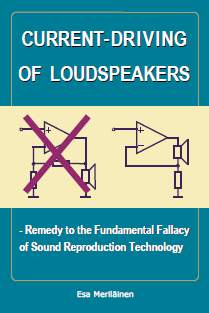
Softcover, 342 pages, available at
http://www.amazon.com/Current-Driving-Loudspeakers-Fundamental-Reproduction-Technology/dp/1448695325/ref=sr_1_1?ie=UTF8&s=books&qid=1254919079&sr=1-1Introduction:Why have the basic laws of electrodynamics been disregarded in the design of loudspeaker operations? A frank exposure of the flaws of voltage drive and a thorough, groundbreaking guide to the physically reasonable way of operating electrodynamic loudspeakers - current-drive. The author argues that the sound quality of virtually all existing speaker systems has been severely impaired by the manifoldly indefinite electromotive forces induced in the voice coil (arising from both motion and inductance), that corrupt the flow of current; and what's dramatic - the measurable evidence is plain and overwhelming! These inherent EMFs in themselves can never be suppressed by any kind of amplifier, but their detrimental effect on current and hence on sonic performance can be eliminated by adequate source impedance. Thus, the secret of valve amplifiers also becomes apparent. Written for all from the academic community to lay hobbyists. Besides new concepts for amplifier and speaker design and demonstrative projects, the book also features novel ideas for modelling, filter design, measurements, and protection; and a useful tutorial on analogue linear systems. For more details, visit
www.current-drive.info.
From the back cover:Is it indeed possible that all audio power amplifiers of the world operate and have operated since their inception - on an all wrong principle? Is it also possible that the sonic aberration caused by this gross technical mistake has substantially impaired our experience with loudspeaker-produced sound, with implications even on the musical evolution of our civilization?
According to laws of physics,
electric current is that which in a speaker driver effects diaphragm acceleration, which in turn produces sound pressure. Yet all power amplifiers strive, often tooth and nail, to control the
voltage at the loudspeaker terminals, which only indirectly affects the current flowing in the voice coil.
Current-controlling loudspeakers is nevertheless not an all-new concept. Some of the benefits it brings, like decreasing of harmonic distortion and expanding of frequency range, have been known at least by specialists. However, there prevails great ignorance about the many grave interference mechanisms that traditional voltage drive inevitably creates and that are fully or partially eliminable by correctly operating current-drive. Also, current-drive does not necessitate active speakers any more than voltage drive does, but amazing improvement in sound quality is achievable by simple means. Based on properties of linear systems and investigation, many other flawed conceptions prevalent in the field of audio technology are also pointed out.
When writing this, virtually no full-range audio equipment operating on the current-principle has yet been seen on the market. One reason may be that controlling the resonance of the bass driver under current-drive has been considered difficult. To resolve this, new handy techniques and circuits are introduced, so that technical obstacles for the extensive utilization of the current-principle are cleared away. Also, it is shown that so-called electrical damping, that pertains to voltage drive, is in reality totally inoperative outside the fundamental resonance region.
The book has been written out with easy-to-understand language for both professionals and interested laymen, so the novel amplifier and loudspeaker realization concepts are made available to all. An ordinary circuit simulator can be used also for predicting the acoustic response, without need for special software. In the appendices is provided valuable basic knowledge about analogue systems.
_____________
Questions and feedback are welcome either here or through my website.
Esa M, the author

