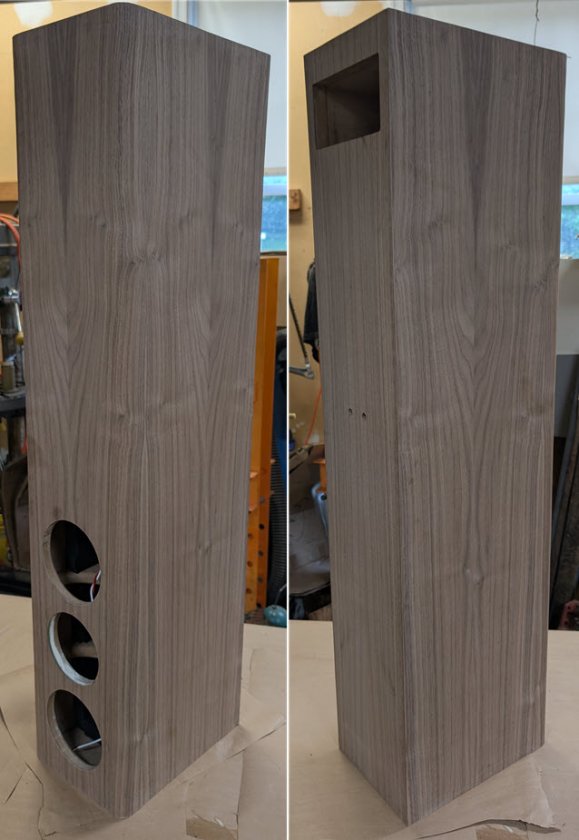
NX-3 Bravo Towers, Standard Build

Rifleman455

  • Jr. Member
  • Posts: 23
NX-3 Bravo Towers, Standard Build
« on: 14 May 2026, 05:31 pm »
I decided to try the NX-3 Bravo towers a la Hobbs for my system.  I also plan to make the enclosures myself because I like to do a bit of Do-It-Yourself (DIY) in my audio world.  I bought the speaker kit from GR Research so all I must do is build a pair of cabinets that my spouse will allow in the living room.  No problem, right?  I plan to build the cabinets as shown in the plans from GR Research.  The only deviation is to add 1/4" slots in the sides to locate the internal braces (more on that later.)

This is not a tutorial on building cabinets or using power tools correctly, just a story of what I did.  I won’t be held liable for anything others do.  If I can answer questions about what I did, please ask!  If you have suggestions for others to improve their build experience or safety, please post them so we all can learn!

I plan to butt-join most of the cabinets using #20 biscuits but will use a router to make ¼” slots in the cabinet sides to hold the braces for easier assembly.  To fit the slots, the internal pieces need to be 7 inches wide instead of 6 ½ inches.

I don’t have a wood shop, but I have a garage with tools in it (and a lot of junk.)  Instead of trying to cut a 4’ by 8’ panel on my table saw and hope to get square edges, I’ll use a track-saw guide (Milescraft 1409) with my 7-1/4” circular saw.  This tool is more affordable for me compared to true track saws that I may only use once.  The track-saw guide lets me make 50” cuts unless I buy another 55” guide track (Milescraft 1408,) so I’ll plan my cutting accordingly.  I also learned that Medium Density Fiberboard (MDF) panels are an inch longer and wider than plywood, so the sheet was 49 by 97 inches.

I bought a 4’ by 8’ sheet of ¾” MDF and had the store cut it at 44” to make it easier to carry.  This is shown as Cut (1) in Figure 1.

Figure 1: Cut Layout for 4-by-8-foot sheet of MDF

I trimmed two adjacent square sides to be my guides and then cut the panel down from 44 to 42 inches.  See Figure 2.  Then I ripped the front and back panels from the 44” sheet with the track-saw guide, cutting them 1/8-inch wider than specified so I could run them through my table saw later to make all the panels the same seven- or eight-inch widths.  I also ripped two long seven-inch planks from the remainder for the internal panels B, D-E, and F.  See Figure 3.

Figure 2: Cut Smaller MDF Sheet to 42 Inches Long

Figure 3: Smaller MDF Sheet Cut into Fronts, Sides, and Braces

From the 53-inch panel, I cut a slab 40-1/2” tall for the side panels and internal braces A, F, and G.  I then ripped the cut-off panel down to ten inches wide for the tops and bottoms.  Then I ripped the side panels from the 40½” sheet with the track-saw guide, cutting them 1/8-inch wider than specified so I could run them through my table saw later to make all the panels the same ten-inch widths.

I cut the fronts, backs, tops, and bottoms eight inches wide on my table saw.  I cut the braces A, B, D-E F, G and H to seven inches wide on my table saw.  The B braces (labeled B1 and B2 in Figure 1) have 5 ½” semicircular cutouts on each end that are easier to make as full circles than as semicircles.  I switch to my router circle-cutting guide (Milescraft 1219) and divided a seven-inch-wide plank into 10-1/8” sections to allow for the 1/8” kerf on my table-saw blade.  I still had to cut a semicircle at each end, but I placed ¾” scrap at each end to support the router.  See Figure 4.  With the holes in place, I cut the plank into 10” lengths on my table saw, as shown in Figure 5.


Figure 4: Cutting Semicircles from Ends of Brace B


Figure 5: Top and Bottom Panels

Next, I cut the sides, tops, bottoms, and the panel for braces B, D, E, and H to ten inches wide on my table saw, as shown in Figures 6 and 7.


Figure 6: Top and Bottom Panels


Figure 7: Braces D-E and H

Two of the D-E-H panels in Figure 7 were cut into 4½” (Brace D) and 5” (Brace E) pieces that were 7” wide.  The other two panels were trimmed to 6-1/2” by 10” for bottom brace H.
With the smaller part of the full sheet rendered into pieces, I turned to the larger part to rip the sides, tops, bottoms, and braces A, F, and G down to size.

I also cut Braces A, F, and G to their specified dimensions using my table saw.  Note that I cut the square for Brace A along a diagonal to make a pair of angle braces needed for the speaker pair.

nlitworld

  • Full Member
  • Posts: 2872
  • Strange things are afoot at the Circle K
Re: NX-3 Bravo Towers, Standard Build
« Reply #1 on: 15 May 2026, 06:01 am »
Looks like you're well on your way with this project. Always love reading up on others' build threads. Just curious, how are you finishing these speakers out? Lots of people can give advice for veneer, but if you're going the painted route I'm more than happy to walk you through the steps.  :popcorn:

Rifleman455

  • Jr. Member
  • Posts: 23
Re: NX-3 Bravo Towers, Standard Build
« Reply #2 on: 16 May 2026, 12:36 am »
Thanks, nlit, for your supportive comments.  I plan to wrap veneer from one side across the front and then across the other side.  We'll see how that turns out!

It's taken me a while to start building, and I've had trouble adding pictures to this topic.  I think that's because the files were too big, but I can't find any data on what "too big" is.  I get locked out of the site for an hour for security reasons, and then I forget to come back.

I'm working on a drawing to show where I located the biscuits on my cabinet, and I'll be post the next update to my assembly with that.  Hopefully, that will happen soon.  Thanks again!

Rifleman455

  • Jr. Member
  • Posts: 23
Re: NX-3 Bravo Towers, Standard Build
« Reply #3 on: 16 May 2026, 12:53 am »
Speaker Holes

Time for more holes!  I laid out the locations on the front panels for the pair of woofers surrounding the tweeter waveguides.  I cut out the simple woofer holes at the specified 4-7/8” diameter, gradually removing 1/8” more material so I wouldn’t overstress my router or bit.  Then, I started cutting the 5.11”-diameter, 0.24” deep recess for the tweeters.  I cut the outermost recess for both tweeters first, reduced the radius of the cut, and cut the next-smaller slice from each recess.  See Figure 8.  Once I had a remaining diameter less than 4.3”, I set the hole diameter to 4.3” and cut the center circle out 1/8” at a pass.


Figure 8: Cutting Tweeter Recesses

With all the panels and braces cut, I switched my router from the plunging circle-cutting guide to the normal configuration with a 3/8” round-over bit with a bearing on the end.  I rounded over the inside of the four woofer holes and rounded over both sides of all internal edges of all braces that do not touch an external panel.

Routing Slots in Panels for Braces

It’s time to  cut slots in the cabinet sides to locate braces B, D, E, F, and G.  To make the 3/4” slots for brace B, I butted to two side together and clamped a straight length of scrap MDF to locate my router at the top of the slot above the tweeter.  I then used my plunge router to remove a bit more than 1/4” deep across both side panels.  I then clamped the straight length below the first cut (toward the tweeter) to locate my router at the bottom of the slot above the tweeter.  I used the plunge router to remove the rest of the 3/4” slot for the top B brace.  I repeated this process to cut the 3/4” slot below the tweeter for the lower B brace (between the lower woofer and the tweeter.)

For braces D, E, F, and G, I must cut slots of different lengths that end in a 3/4”-diameter round-over into the sides.  One way to do this is to butt the sides along the rear edges, clamp straight guides and stops to the sides, and cut the slots using a plunge router with a 3/4” straight-cut bit.  I didn’t want to do this because of past work with plywood that is thinner than its 3/4” specification.  It turns out that MDF is accurately sized at 3/4” so the method would work fine, but I decided to use a smaller-diameter router bit and sneak up to the correct slot width.  That means I needed a template to cut the rounded-over portion on each slot as well.

Here, I went overboard and designed a group of plastic templates that I printed on my 3D printer.  See Figure 9.  Because I can only make a part up to ten inches cubed, I made a template for each of the four slots and connected them with locating pins.  I used the same pins to locate the assembled jig to the front, back, and bottom edges of the first side.  I added a bronze bushing to my router base that follows the templates and used a 3/8” upcut bit to gradually make the slots a 1/8” at a time.  To cut the other side, I flipped the template over and cut the remaining slots.


Figure 9: Routing Template for Brace Recesses

Next time, I'll talk about placing biscuits!  :D Yum!


Rifleman455

  • Jr. Member
  • Posts: 23
Re: NX-3 Bravo Towers, Standard Build
« Reply #4 on: 16 May 2026, 06:36 am »
Hungry for Biscuits!

With all the panels cut to size and the internal slots cut for the braces, it was time to start assembling the cabinet.  To make the glue-up easier and control sliding while clamping, I used wooden biscuits to locate each of the six panels with respect to each other.  Slots were cut into the edges of the sides and into the surfaces of the top, bottom, back, and front.  I located the biscuit slots away from the brace slots for optimum strength.  See Figure 10.


Figure 10: Back-Panel Biscuit Locations


Figure 10: Front-Panel Biscuit Locations


Figure 10: Side-Panel Biscuit Locations


Figure 10: Top- and Bottom-Panel Biscuit Locations

By fitting dry biscuits into the slots, I found it easiest to assemble the speaker by starting with the back lying down, adding each side panel, then adding the top and bottom panels to form an open box.  After that, the front of the cabinet is fitted to the cabinet as shown in Figure 11.


Figure 11: Cabinet is Dry-Fitted using Dry Biscuits

I noticed immediately that I would not be able to reach the lower chambers of the transmission line through the speaker holes if I completely glued the cabinets.  My first thought was to leave off the front panel and work around the internal braces.  Another approach would be to assemble one side to the back, and glue in the internal braces.  Then I can attach the No Rez and crossover network to the back and side panels.  Hopefully, I could then add No Rez to the remaining panels and glue them to the existing structure.  This way, I wouldn’t have to reach blindly around the cabinet trying to measure and stick pieces in place.

Let me experiment with these approaches and I'll let you know how it turns out.

tremrej65

Re: NX-3 Bravo Towers, Standard Build
« Reply #5 on: 16 May 2026, 01:28 pm »
I love this type of thread.
Good job.
I should get a biscuit joiner. It's probably easier to use then dowel for alignment.

Rifleman455

  • Jr. Member
  • Posts: 23
Re: NX-3 Bravo Towers, Standard Build
« Reply #6 on: 16 May 2026, 05:22 pm »
I should get a biscuit joiner. It's probably easier to use then dowel for alignment.

Thanks for the kind words!  I haven't used anything but the biscuit joiner, but it has surely helped me bu letting me dry-fit panels and helps prevent slipping panels when gluing: my friends have had panels slide once the glue is down while trying to clamp them.  A biscuit joiner was cheaper than a domino joiner (!)  I placed my panels on my table saw to hold them flat, and so I could use the fence as a vertical guide for the perpendicular slots.

Rifleman455

  • Jr. Member
  • Posts: 23
Re: NX-3 Bravo Towers, Standard Build
« Reply #7 on: 16 May 2026, 07:05 pm »
Starting to Assemble

As I mentioned, I started assembly with a timid approach of gluing the right side and the six braces to the back.  This may have been a good approach because it took over nine minutes to apply glue to all the biscuits, slots, and butt joints, and the Titebond III PVA adhesive I’m using recommends an open (working) time between eight-to-ten minutes.  Note that I used 120-grit sandpaper to rough up the MDF surfaces where the side panel butts to the back before gluing.  I squirted glue on the slots and panels and then used what I know as a solder-flux brush to evenly apply a layer of glue about 1/32” thick.  I also had a glue bottle with a biscuit attachment that let me quirt glue into the bottoms of the slots.  Then I assembled the braces and side to the back panel.  Next, I dry-fitted the left side, top, and bottom panels to align the parts and clamped the joints together.  The adage is that you can never have enough clamps.  I’ll have to get some longer clamps to span 42 inches from the top to the bottom!

After waiting a day for the glue to fully cure, I removed the clamps and dry-fitted panels.  The result is shown in Figure 12 with the left side laying down.


Figure 12: Side, Back, and Braces Glued Together

Because I cannot reach the lower chambers of the transmission line with the front panel on, I started to fit pieces of No Rez into the cavities.  I vacuumed the surfaces and then used a tack rag to remove any dust that might affect adhesion.  Then I realized that it will be easier to fix the crossover into the cabinet before further assembly because I’ll have more room to move about.  I can also accurately lay out wire lengths.  Now all I need is a crossover!

I referred to YouTube videos on the GR Research channel and to the schematic provided with the speaker kit to build the crossover.  My resulting 1/4”-plywood board is shown in Figure 13 with the obligatory masking of component values to protect GR’s intellectual property.


Figure 13: Assembled Crossover Board.

The board is 9” long and 5-3/8” wide.  It will be installed on the back panel behind the lower woofer.  The No Rez will be installed around the crossover because this is what I’ve seen in other GR videos.  I wonder if there is benefit from installing a piece of No Rez backing without the foam onto the back panel underneath the crossover?  Maybe Danny or Hobbs will chime in!

Off to do chores!  :notworthy:

BlindFalcon

  • Jr. Member
  • Posts: 13
Re: NX-3 Bravo Towers, Standard Build
« Reply #8 on: 17 May 2026, 10:38 am »
Looking good Rifleman.  This kind of post gives me the confidence to try more complicated builds.  I’ve only used flat packs to this point.  And it’s good to see how much work is involved to put these cabinets together.  I sometimes assume it just takes me longer than others to get these things together.  Really looking forward to seeing your veneer as I’m about to try that for the first time.  Keep the pictures coming!

And I just ordered a circle jig for my router, more tools!

Rifleman455

  • Jr. Member
  • Posts: 23
Re: NX-3 Bravo Towers, Standard Build
« Reply #9 on: 17 May 2026, 08:52 pm »
Falcon,
I'm glad to give anyone a reason to buy more tools (even if we only use them once!)  I think that's the idea of new projects: a chance to buy more tools!

Note about Crossovers:
In my last blurb, I built my crossovers so I could install them before permanently attaching the front panel.  That's a good thing because I made my boards too big to pass through the woofer holes.  :duh:

I didn't post the cabinets plans but they are available from the GR-Research site.  The woofer holes are 4-7/8" in diameter, and my crossover board is 5-3/8" wide!  If I wanted to install (or ever remove) the crossover through the hole, I should have considered the hole size and the height of the parts above the board.

One option is to include a removable panel that gives access to the crossover.  This could be combined with the speaker terminals if desired.  Or the cabinet bottom could be removable to allow crossover mounting there.  I didn't want to do that because the transmission line (TL) port is located at the cabinet bottom.

Another option is to split the crossover into high-pass and low-pass sections.  Both would be smaller than my big honker and should fit though the driver holes. In my spare time I'll try a suggested layout for a duo of boards for the crossover that should pass through the driver holes.  Hopefully, I won't forget.

These approaches will use more interconnect wires, so keep that in mind.

And I've seen many people mount their crossovers outside of the cabinet.  If they aren't hard-wired, then more tube connectors are needed.  I didn't want to subject my crossovers to more dust and pet attacks, so I planned to install them inside the cabinet.

So, I need to think about my path to completion, not just the final result.  Beware the excitement of jumping ahead, but don't stall due to overthinking.
« Last Edit: Yesterday at 07:39 pm by Rifleman455 »

Tyson

  • Full Member
  • Posts: 11726
  • Without music, life would be a mistake.
Re: NX-3 Bravo Towers, Standard Build
« Reply #10 on: 17 May 2026, 09:01 pm »
Yes the fitting of the crossover through the woofer hole is often tight.

Nice work so far, can't wait to see the veneering when it's done.
« Last Edit: 17 May 2026, 10:20 pm by Tyson »

Rifleman455

  • Jr. Member
  • Posts: 23
Re: NX-3 Bravo Towers, Standard Build
« Reply #11 on: 17 May 2026, 10:47 pm »
Here is a suggested arrangement for the NX-3 Bravo crossover that will fit through the driver holes.  I haven't built these, but they should work.  In the first figure are the low-pass filter components.  They fit on a board 5-7/8" long by 3-1/8" high.  The accompanying figure shows it passing through a 3-3/4" hole, which is smaller than the 4-7/8" woofer holes.  I have tucked some of the resistors under the edge of capacitors to save space.  The resistors should be glued to the board to stabilize them.


The next figure shows a possible layout for the high-pass filter components. They fit on a board 5-1/4" long by 3-1/8" high.  The accompanying figure shows it passing through a 3-3/4" hole, which is smaller than the 4.3" tweeter-waveguide hole.


Both appear to have room to mount on the back panel directly behind the drivers.
Because I've already built my combined crossovers and tested them to make sure they work, I'm going to plow ahead and mount them in my cabinets.  I shouldn't have problems until the capacitors go bad.  At that time, I'll have to get out the saw.  :o :nono:
« Last Edit: Yesterday at 07:44 pm by Rifleman455 »

Rifleman455

  • Jr. Member
  • Posts: 23
Re: NX-3 Bravo Towers, Standard Build
« Reply #12 on: 17 May 2026, 10:50 pm »
Nice work so far, can't wait to see the veneering when it's done.

Thanks, Tyson, I can't wait either!  It may why I'm scrambling and forgetting things on the way.  The veneering has me a bit nervous!

Rifleman455

  • Jr. Member
  • Posts: 23
Re: NX-3 Bravo Towers, Standard Build
« Reply #13 on: Yesterday at 09:21 pm »
It has been a couple of weeks, so I'd better post an update!

Assembling Cabinet with No Rez and Crossover.

Before adding the other side to the back panel, I wanted to install the No Rez to the lower chambers that I didn’t think I could easily reach with both sides on.  (I’m going to try something different with the second cabinet, so stay tuned.)

Of the ways suggested to cut No Rez sheets, I settled on using a utility knife augmented with shop scissors.  Marking the slick peel-off backing of No Rez was a challenge because pencil left no trace and Sharpies beaded up.  I ended up using dashes made of beading ink to show where I should cut and followed them the best I could (See figure 14A).


Figure 14A: Beading-Ink Markings on No Rez Peel-Off Backing.

I used a utility knife firmly along the dashed lines repeatedly until I cut through the thick backing and through most of the foam, as shown in figure 14B.  I then cut any foam still attached to the sheet with shop scissors to separate my piece from the sheet.


Figure 14B: No Rez Installed on Back and Side Panels.

Before sticking a piece of No Rez to the cabinet interior, I vacuumed the area and then wiped the area down with a tack cloth to remove dust.  I then peeled the backing off and pressed the No-Rez pieces into place as shown in figure 15.  Note that I also installed the crossover without No Rez behind it in the space behind the lower woofer so that I knew where not to stick No Rez.


Figure 15: No Rez Installed on Back and Side Panels.

With that done, I glued and clamped the side and applied No Rez to the left side.  Then I glued and clamped the top and bottom panels in place aided with the wooden biscuits.  I also glued the H brace to the bottom of the cabinet.  I used Gorilla Glue cyanoacrylate (CA) glue to attach the A brace to the top and back of the cabinet because clamping would have been difficult.  It seems to have worked.  Figure 16 shows the inside of the front panel with No Rez mounted, ready to be glued to the rest of the cabinet.  You can see the crossover between the cabinet parts on the table behind with wires soldered and ready to be installed for the last time.


Figure 16: Front Panel Ready to Glue to Rest of Cabinet.

Cut the Transmission-Line Opening

Before closing the cabinet, the rear opening for the port needed to be made.  I used a router and a 1/4” straight bit with a bottom bearing.  First, I drilled a 3/8” hole inside the boundary of the port (see figure 17A), inserted the router bit, and cut until I found the side boundary wall.  From there, I cut around the port using the internal walls (see figure 17B) until I had cut around the whole port, as shown in figure 17C.  With the cabinet interior vacuumed out, I glued and clamped the front panel into place.  Once the glue was cured, I rounded over the front vertical edges of the cabinet with a 3/4” router bit.


Figure 17A: Pilot Hole for Port Opening.


Figure 17B: Cut to Boundary Wall and Follow Around Opening.


Figure 17C: Finished Port Opening.


Figure 18: Front Vertical Edges Rounded Over.


Rifleman455

  • Jr. Member
  • Posts: 23
Re: NX-3 Bravo Towers, Standard Build
« Reply #14 on: Yesterday at 10:15 pm »
Second Cabinet: Alternate Approach

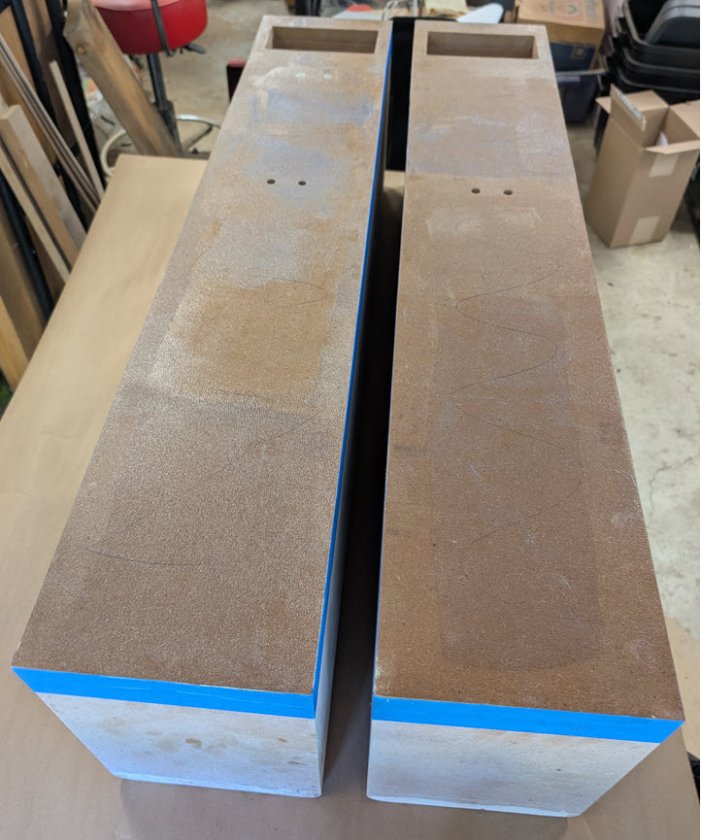
Before assembling, I had to cut all the brace and biscuit slots in the pieces I cut earlier with the first cabinet.  One of my mistakes was not to cut all my biscuits slots before cutting the holes in the front panel.  To cut biscuit slots, I must mark their locations on the panels so I can line up the cutter.  This is not a problem when adding a slot to a panel edge because the edge index on my cutter is easily visible.  To cut slots on a panel face, however, the folded cutter shoe blocks the index, so I had to use a different index that was inches away from the slot location.  This meant that I had to mark index lines that were five-to-six inches long.  When I cut the driver holes, I removed the panel material that should have index marks on it, as inferred from figures 10 and 16.  Instead, I covered the driver holes with blue painters’ tape and marked that instead.  See Figure 19.


Figure 19: Use Painters’ Tape for Biscuit Index Marks.

Now that I figured out how not to do certain things, I built the second cabinet in a different order: I glued braces B, D, E, F, G, and H (right to left in figure) to both sides to make my starting assembly, as dry-fit in figure 20.


Figure 20: Braces Fitted to Both Sides of Second Cabinet.

Note that I did not understand my drawings in figure 10 and mistakenly cut biscuit slots on the inside top (right side in figure) of the side panels!  I added the correct slots on the edges, and hope that the glue does not run out the inside slots.  Maybe I should fill those inside slots and recut the edge slots?

Also note that the biscuit cutter got away from me at the top right of the side panel and cut a slot too near the outside edge.  I cut the correct slot and cut down a biscuit that I will glue into the mistaken slot and then sand smooth to strengthen that part of the panel.  That area will be exposed when I round over the front edges, so more filling may be needed.

After I glued the braces and sides together, I slid the top, bottom, back, and front panels into place using biscuits to make sure all the pieces were in the right place.  I separated these panels with wax paper so they would get stuck in any glue that squeezed out.

Aside:  I received my 4’-by-8’ sheet of paper-backed walnut veneer to wrap these cabinets.  I am very new to veneering so this should be interesting!

Rifleman455

  • Jr. Member
  • Posts: 23
Re: NX-3 Bravo Towers, Standard Build
« Reply #15 on: Yesterday at 10:22 pm »
Also note that the biscuit cutter got away from me at the top right of the side panel and cut a slot too near the outside edge.  I cut the correct slot and cut down a biscuit that I will glue into the mistaken slot and then sand smooth to strengthen that part of the panel.  That area will be exposed when I round over the front edges, so more filling may be needed.

I was wrong: the part of the side panel with the mistaken slot will not be exposed by the round-over: only the front panel is affected.