Sorry, I got so busy, I haven't had time to post some ideas.
It is my impression, that you need an acoustical intervention, but can't place wall/floor/ceiling treatments in a fixed manner.
I don't want to write an encyclopedia, but there are other means and methods for controlling sound, that are equally effective and can be employed "only" while engaging in High Performance 2 Channel Listening.
I have to start at the beginning, which is early loudspeaker design. Early on, the goal of a loudspeaker was to present sound to a space via directivity and dispersion in a manner that offered a broad area of covering the space being targeted. That is , as much as possible "uniform dispersion" to all of the space. This is an admirable goal for PA systems, and Live Music venues, but falls down in a home music system. The reason is that this uniform coverage creates substantially more reflected sound, (distortion) than accurate direct sound to your ears.
This led to various types of horns, wave guides and devices to produce broad even dispersion over a larger area. Only problem with this is that such directivity produces maximum reflections, which interfered with the program material as the reflected sound bounced around the room.
It also led to the development of speakers that attempted to use reflected sound (usually dipolar) to create a MIRAGE via "employing" reflected sounds, which is quite pleasing, but ultimately not accurate to the original recording This is quite popular via dipolar speaker designs, especially because it sounds wonderfully pleasing.
All and all, ANY REFLECTED SOUND not arriving directly from the drivers to your ears IS A DISTORTION to the source. So, most end up living and listening to more distortion, than pure sound. That is you don't just listen to your system, you listen to your ROOM.
This spawned a whole industry of Acoustical Room Treatments. where you deal with the reflected distortions by mounting as many acoustically absorbent panels as your wife, or budget will allow. This is ALL to reduce these reflections.
This method I am suggesting, works from another angle. It blocks, impedes, or reduces the sound that would eventually be reflected off walls, and ceiling; BEFORE it gets there. If you can employ this method with your speakers, the clarity, and realism will be very impressive, and in the simple method I suggest not that expensive or permanent.
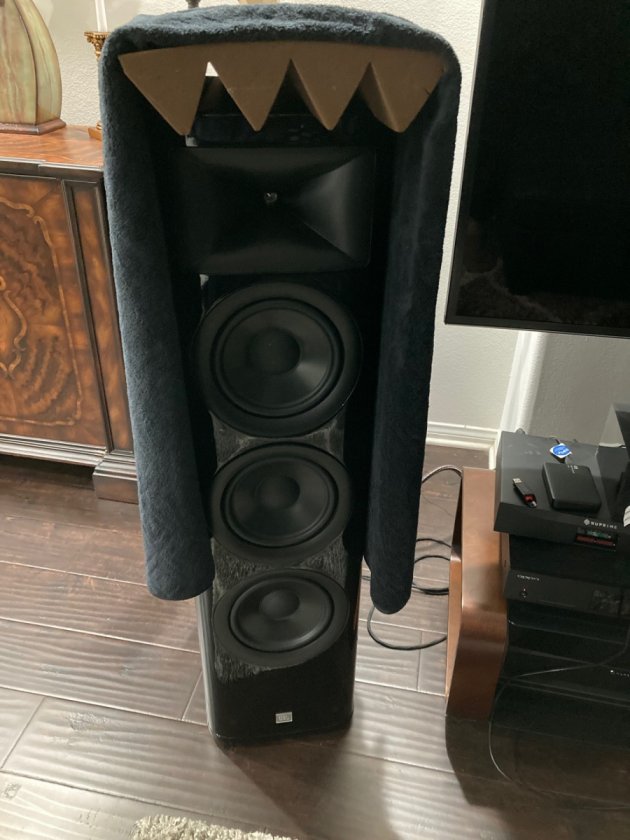
It consists of placing sound absorbing materials over and around the speaker and about 6" (may vary) out from the speakers face. This effectively blocks, or reduces the sound you don't hear directly, which is the ONLY important sound, if you want accuracy over mirage.
And wonderfully you can remove the materials and shove them in a closet until such a time as you wish to engage in High Performance Listening again. The ultimate in simplicity.
I use a BIG Fluffy Beach Towel, with a piece of acoustical foam underneath to support the towel at the top and allow it to overhang the top section, and will effectively reduce ceiling reflections. See photos for a clearer picture of the application. I have also occasionally added a 3rd layer of a "Moving Pad or Blanket" over this contraption. (not shown, but the thickness and absorbency is HIGHLY effective.)
This will have virtually no effect on lower and bass frequencies, but is incredible above that. And has a side benefit of blocking "side cabinet resonances" which are also a problem sonically with many speaker types.
Sorry this was so long, but to some it will be a paradigm shifting or radical concept..
Just remember, it will allow you to hear all the DIRECT sound from the drivers, and reduce the reflections at the source, instead of covering your walls with expensive, and not often pleasing panels.
In the end, it will move towards the purity of sound you achieve from headphones, but with sound staging and imaging intact, which will be more accurate and precise.
If you have questions, let me know, and if you try it, be prepared to have a realigning of what you thought yours system and speakers actually sounded like. And also please be aware, this may not work for your specific speaker brand or model, and this is where a little "Yankee ingenuity" may be needed to try it.
If one enjoys listening to their ROOM, then. . .never mind 🙂