We hope you were able to enjoy a relaxing time with family and friends over the holiday. Like many of you, I am ready to turn the channel on most of those too familiar songs and get back to a more diversified audio portfolio.
Two topics in this update - The Dawn preamplifier and a long term product review we have been living with for about 6 months.
The Dawn PreamplifierWe are inching closer to the official launch and we are very excited about the performance and quality. After receiving feedback from a number of trusted friends, we have modified the architecture to allow for a balanced input option. And, the Dawn has a dual-mono output power supply. These two changes provide flexibility and a meaningful upgrade in sound that we did not want to put off.
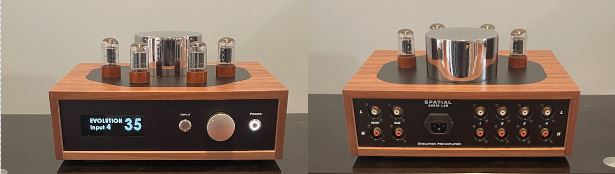
Prototype shown - Walnut (final version will be darker)
Reservations are now open exclusively for our newsletter subscribers by following this link. $1,000 deposit and balance due prior to delivery. Shipping expected to begin in April of 2026.
www.spatialaudiolab.com/dawn-preamplifier-1Long Term DAC Review - Linear Tube Audio Aero DACLTA is a well-respected manufacturer in our community and a long-time friend of Spatial Audio Lab. As you probably read in the last newsletter, our S4 speakers are available at the LTA listening room at their Maryland location. In the interest of full disclosure I will say we approached Mark and Jacob early in 2025 about making a trade so that we could have the Aero DAC as part of our test bench and we have been very impressed.
Cloud Sessions has spent quite a bit of time with the Aero and took time to put into writing his impressions. Warning: The following is opinion and should be read that way. Your experience may vary. TLDR; we highly recommend the Aero. As the British say, it’s a great piece of kit and a tremendous value.
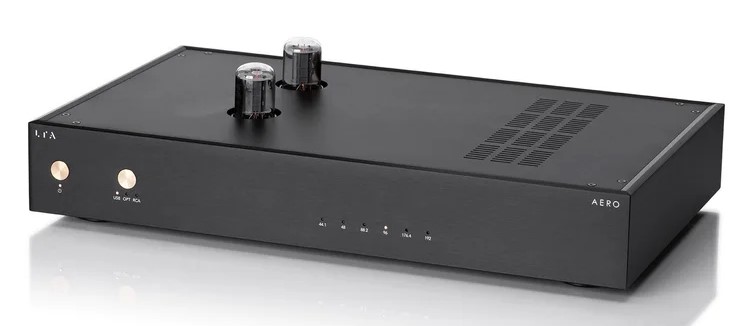
I was fortunate to spend several months living with the LTA Aero DAC, using it across four different systems and with six different tube sets. That extended time was valuable. Because, the Aero is not a DAC that reveals itself through quick impressions or spec chasing. It’s a component that makes sense once you stop listening at the music and start listening through it.
Starting with the basics, the build quality feels entirely appropriate for the price point. It’s solid, well put together and thoughtfully packaged. Nothing about it feels fragile or underdeveloped. Burn-in was not extensive in my experience; after a couple of days of continuous use, I felt I was already hearing the majority of what the Aero had to offer. Over time, it relaxed slightly and became more coherent. But, there was no dramatic transformation required to get to its core sound.
In terms of connectivity, I found both balanced and single-ended outputs to sound equally good with no clear preference emerging in my systems. USB was consistently very strong and would satisfy most listeners without question. That said, when paired with a truly high-end digital front end, the SPDIF input clearly had more headroom to scale. With the right streamer upstream, SPDIF allowed the Aero to step into a different league entirely. I should note that the Aero works best when it is not asked to drive extremely low-impedance amplifier inputs. It functions well into reasonably low impedance loads. But, if an amplifier presents a very demanding input, I wouldn’t consider the Aero an ideal match. I also noted a very faint hiss at full volume with no music playing; audible only at the speaker and only on the B+ setting. This was extremely minor and not something that would concern me in real-world use, but it is worth mentioning for completeness.
Sonically, the Aero DAC is not about chasing hyper-resolution, spotlighted detail, or exaggerated frequency extremes. Its primary focus is on creating a convincing musical performance — one where the speakers disappear and instruments occupy believable, stable positions in space. The depth and holographic layering it produces are exceptional for its price category, and in this regard it competes with DACs that cost meaningfully more. The Aero prioritizes timing, flow, and spatial organization over extracting every last microscopic nuance from a recording. This makes it a DAC clearly aimed at experienced listeners who want digital playback to sound smooth, layered, and emotionally engaging rather than relentlessly analytical.
Where the Aero truly becomes special is when it is paired with a genuinely high-end streamer over SPDIF. With a source that employs SC-cut clocks, excellent isolation, and serious power supply implementation, the Aero transforms into the most analog-sounding digital playback I’ve personally heard. Transients sound natural and unforced, temporal information feels correct, and the overall presentation is so fluid and believable that it genuinely challenges your assumptions about digital playback. I have heard very expensive DACs, and I can’t recall another that crossed this particular line as convincingly. That said, achieving this level of performance does require an upstream digital chain that may ultimately cost more than the DAC itself.
Looking more closely at its tonal balance, the Aero’s treble is smooth and slightly polished, but not rolled off. It remains extended and airy, yet relaxed enough to encourage long listening sessions. The midrange reflects a very modern interpretation of tube sound. There is warmth and richness present, but it is lighter and more agile than traditional tube designs. If you are familiar with LTA’s house sound, that signature remains intact: articulation and clarity take precedence over sheer density and weight. I would describe the midrange as just slightly warm with a refined polish. On the positive side, this polish allows space between instruments to breathe and prevents congestion during complex passages. On the downside, it does mean that the Aero does not extract every last bit of inner texture or harmonic nuance in the midband. There are DACs at higher price points that do this more explicitly, and listeners who prioritize that quality above all else may prefer a different presentation.
Interestingly, this voicing makes the Aero particularly well suited to modern recordings. Pop, electronic, and contemporary productions benefit from its clarity, spatial organization, and restraint. Genres that rely heavily on dense harmonic information — such as small-ensemble jazz, singer-songwriter material, or purely acoustic recordings — still sound very good, but the Aero does not foreground harmonic complexity in the way some other DACs do.
The bass follows the same design philosophy. It is quick, articulate, and well integrated with the midrange and treble. The Aero emphasizes speed and definition over sheer slam. Bass notes start and stop cleanly, with good pitch clarity, but there is again a touch of polish. On modern recordings this works extremely well, while on acoustic material some of the deepest harmonic structure and texture can be slightly smoothed over. This was never a deal-breaker for me, but listeners who place maximum importance on bass texture and bloom may want to factor this into their decision.
Tube rolling allows some shaping of the presentation, but the Aero’s fundamental harmonic character remains largely intact regardless of tube choice. Both sets of 12SN7 tubes supplied with the unit are excellent matches and clearly chosen with care. They help balance the DAC’s inherent polish by adding body and texture while preserving its outstanding soundstage and image delineation. By contrast, I was less enthusiastic about the Ray Reserve upgrade tubes. While impressively quiet and expansive in soundstage, they lean further into a modern, highly polished presentation. In the Aero, this doubled down on its existing tendencies, resulting in a midrange that felt overly refined and lacking in inner harmonic texture. This combination can work well with certain compressed or early-2000s recordings, but for me it diminished some of the beauty and tonal richness the Aero is capable of. Based on my experience, I would strongly encourage anyone considering the Aero to explore high-quality NOS 12SN7 tubes. There is a reason LTA supports them, and the best results I heard came from NOS examples in my own collection.
Taken as a whole, the LTA Aero DAC is not a box designed to impress in five minutes. It is designed to disappear into a system and allow music to unfold naturally, with exceptional spatial realism and a sense of flow that is rare at its price. For listeners who value musical coherence, depth, and long-term engagement over sonic fireworks, the Aero offers something genuinely special — especially when partnered with a high-quality digital source.
Thanks,
Cloud
Pre-Owned OpportunitiesLegacy M5 Sapphire Speakers - 15” WooferIf you are in the market for one of a rare breed of open baffle speakers, you may be interested in this pair of M5 Sapphires available on US Audio Mart. I spoke with the owner and he is downsizing his audio room and equipment. We haven’t built a crossover upgrade for this model. But, if you purchase this set, we can arrange to get that done for you prior to having them shipped to you. (We would work with the seller to coordinate the logistics.)
You can find out more here:
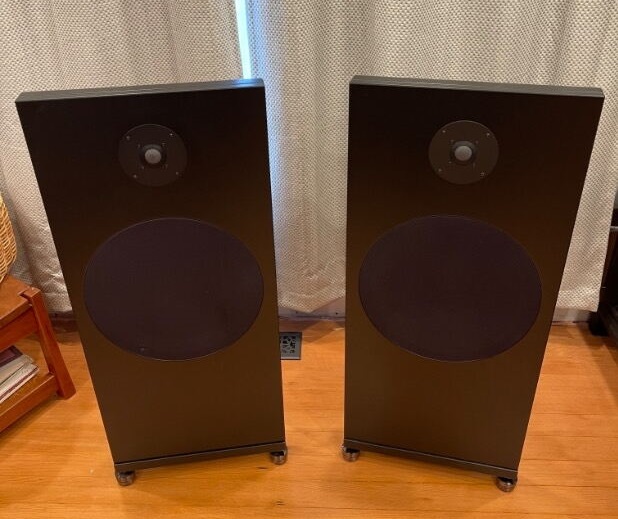 www.usaudiomart.com/details/650285038-spacial-audio-lab-m5-sapphire-with-iso-acoustics
Thank you for your ongoing support and enthusiasm!
David Whitt, General Manager

