This article from 2003 is obsolete. They even changed the traditional audiophile term Soundstage to Headstage to match their website name.
In 2003 the best HP available was the HD600/650 (except top $ Stax etc) now also outdated. Until today 2026 the bigger Soundstage available is the HD800, which was only released in January 2009.
You didn't read the Link about Soundstage that I pointed to you in this other topic.
https://www.audiocircle.com/index.php?topic=193562.0Found that Rtings.com developed a system to measure Soundstage headphones, which is a tremendous useful feature, we dont need anymore buy a HP to know how is its soundstage size:
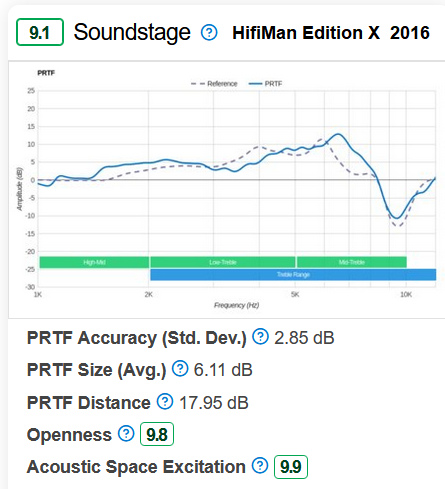
https://www.rtings.com/headphones/tests/sound-quality/soundstageThe main factor is PRTF Distance (Pinna Related Transfer Function) showed in the chart below, which is created by phase cancellations at 10kHz in the concha between the driver and the ear.
HE400i PTRF chart show it is almost good, lacking a deeper groove in 10kHz:

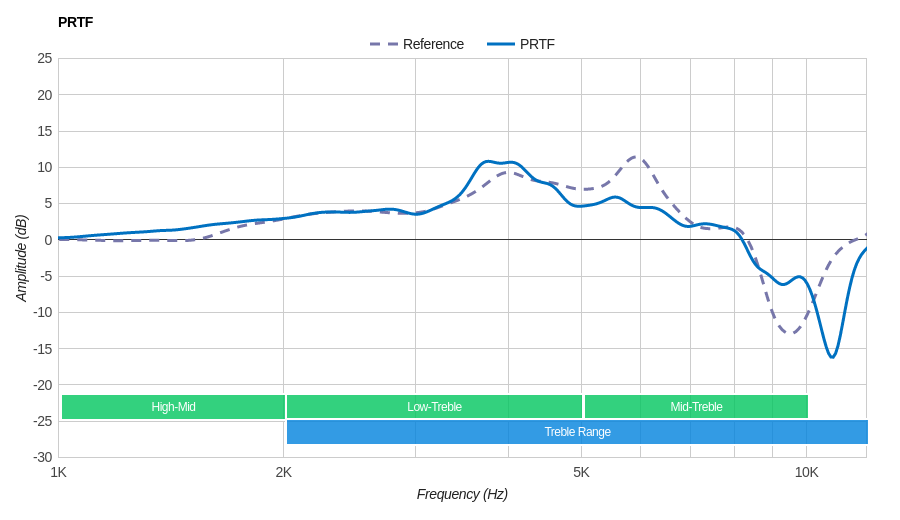
The larger soundstage is the HD800 that measured
PRTF Distance: 22.36dB https://www.rtings.com/headphones/reviews/sennheiser/hd-800-sHD800 PTRF chart:
Also there is this other AC topic about Soundstage:
https://www.audiocircle.com/index.php?topic=159192.msg1700150#msg1700150= = = = = =
Our PRTF test replaces the Passive Soundstage test that appeared in all headphone reviews prior to Test Bench 2.0. While PRTF isn't entirely new, it was re-formulated as we felt it didn't represent a complete assessment of what constitutes soundstage.
Soundstage determines the space and environment of sound, as created by the headphones. That is, it determines the perceived location and size of the sound field itself, whereas tests like Stereo Mismatch and Group Delay have more of an effect on the location and size of the objects within the sound field. In other words, soundstage is the localization and spatial cues not inherent to the audio content (music), and headphones have to 'create' them rather than 'reproduce' them.
Our pinna-related transfer function (PRTF) test measures the amount of interaction between the pinna and headphones. While it's not a comprehensive and complete measurement of soundstage, interaction with the pinna plays a significant role in the perceived distance and size of the sound field. Our test comprises three separate tests: PRTF Accuracy (Std. Dev.), PRTF Size (Avg.), and PRTF Distance.
What it is:PRTF (pinna-related transfer function) of the headphones compared to a reference loudspeaker's PRTF at 30°. This quality is monaural and can be perceived even with one ear.
When it matters:
The interaction with the pinnae may give partial insight into the soundstage performance of the tested headphones.
Score components:
15.0%
PRTF Accuracy (RMS Deviation)
15.0%
PRTF Size (Avg.)
35.0%
PRTF Distance
When It MattersA high PRTF score can contribute to a large, out-of-head, and immersive soundstage. This is mostly important for audiophile, home theater, and gaming usages. Headphones with a good soundstage give a sense that the music is happening in front of you, in a room you are sitting in, and not in a vacuum in your head. For gamers, this can be particularly useful in adding a sense of realism and an immersive quality to games. Creating a good soundstage is one of the hardest things to do for headphones, and almost no headphones currently available can mimic a speaker-like soundstage. It's worth noting that while our PRTF test uses comparisons with a loudspeaker as a reference point, this won't necessarily determine whether you'll like or dislike the sound.
Unless a large and speaker-like soundstage is needed or highly desired, most users will be happy with headphones that lack an expansive sound, which also make up the majority of the casual-use headphones market. Earbuds and in-ears, for example, bypass the pinna entirely and will struggle to produce a speaker-like soundstage (though they can still reproduce spatial cues to some extent). That said, many people still prefer how they sound. It's possible that some people won't even notice the lack of it, or not be bothered by a small and inside-the-head soundstage until they compare it with a good stereo loudspeaker setup or a pair of headphones with a good soundstage.
What it is:
PRTF (pinna-related transfer function) of the headphones compared to a reference loudspeaker's PRTF at 30°. This quality is monaural and can be perceived even with one ear.
When it matters:
The interaction with the pinnae may give partial insight into the soundstage performance of the tested headphones.
Score components:
15.0%
PRTF Accuracy (RMS Deviation)
15.0%
PRTF Size (Avg.)
35.0%
PRTF Distance
Score distribution
Our PRTF test replaces the Passive Soundstage test that appeared in all headphone reviews prior to Test Bench 2.0. While PRTF isn't entirely new, it was re-formulated as we felt it didn't represent a complete assessment of what constitutes soundstage.
Soundstage determines the space and environment of sound, as created by the headphones. That is, it determines the perceived location and size of the sound field itself, whereas tests like Stereo Mismatch and Group Delay have more of an effect on the location and size of the objects within the sound field. In other words, soundstage is the localization and spatial cues not inherent to the audio content (music), and headphones have to 'create' them rather than 'reproduce' them.
Our pinna-related transfer function (PRTF) test measures the amount of interaction between the pinna and headphones. While it's not a comprehensive and complete measurement of soundstage, interaction with the pinna plays a significant role in the perceived distance and size of the sound field. Our test comprises three separate tests:
PRTF Accuracy (Std. Dev.), P
RTF Size (Avg.),
and PRTF Distance. A high PRTF score can contribute to a large, out-of-head, and immersive soundstage. This is mostly important for audiophile, home theater, and gaming usages. Headphones with a good soundstage give a sense that the music is happening in front of you, in a room you are sitting in, and not in a vacuum in your head. For gamers, this can be particularly useful in adding a sense of realism and an immersive quality to games. Creating a good soundstage is one of the hardest things to do for headphones, and almost no headphones currently available can mimic a speaker-like soundstage. It's worth noting that while our PRTF test uses comparisons with a loudspeaker as a reference point, this won't necessarily determine whether you'll like or dislike the sound.
Unless a large and speaker-like soundstage is needed or highly desired, most users will be happy with headphones that lack an expansive sound, which also make up the majority of the casual-use headphones market. Earbuds and in-ears, for example, bypass the pinna entirely and will struggle to produce a speaker-like soundstage (though they can still reproduce spatial cues to some extent). That said, many people still prefer how they sound. It's possible that some people won't even notice the lack of it, or not be bothered by a small and inside-the-head soundstage until they compare it with a good stereo loudspeaker setup or a pair of headphones with a good soundstage.
How It WorksOur benchmark for the ideal headphones' soundstage is the ideal full-range, stereo loudspeaker setup, in a reflection-less room. Although no such ideal setup exists in the real world, this provides a good theoretical basis for determining the components of the soundstage. Based on this framework, the differences between loudspeakers and headphones in terms of localization and spatial qualities, i.e., soundstage, can be divided into three:
Room effects: With loudspeakers, the music is happening in a room where the sound is affected by reflections off the walls and other surfaces, as opposed to headphones, where the music is happening at or in your ears.
Angle, sound source, and pinna interaction: Loudspeakers are positioned out in front and at a 30-degree angle, but headphones are usually at a 90-degree angle and very close to the eardrum. The pinna (the outer ear), which is part of the individual's HRTF (head-related transfer function), has a major role in helping the human auditory system to localize the angle and source of the sound. Since the shape of the pinna is very complex and asymmetrical, both vertically and horizontally, depending on the location of the source, different pinna resonances become active. These resonances add direction-specific patterns into the frequency response of the ears, which is then recognized by the auditory system for up/down and front/back localization.
Crosstalk: With a stereo loudspeaker setup, some of the sound from the left speaker reaches the right ear, and vice versa, because there's no separating barrier between them. But with headphones, the sound of the L driver doesn't get to the right ear, due to the shadow created by the head. In a stereo speaker setup, the role of crosstalk is to strengthen the phantom center and to make the stereo image more cohesive; in other words, to remove the hole in the middle of the sound field, which is a characteristic of headphones' soundstage.
= = = = = =
PTRF Distance value is derived by calculating the difference between the "average PRTF amplitude of the 2KHz-7KHz range" (i.e. PRTF Size), and the "lowest PRTF amplitude value in the 8KHz-12KHz range". In other words, PRTF distance looks for the depth of the 10KHz notch, which is mostly responsible for cues regarding the angle and elevation of the sound source.
As a rule of thumb, headphones with angled drivers and large and deep enclosures have the best PRTF responses. That's why over-ear headphones tend to do better than on-ears, earbuds, and in-ears in this test.
What it is: Soundstage qualities are not inherent to the audio content, the headphones have to 'create' them rather than 'reproduce' them. They determine whether the sound is perceived to be coming from inside or in front of the head, how open and spacious the soundstage is, how much the headphones acoustically interact with the environment, and how strong the phantom center is. The depth of the "10KHz notch" of the headphone's PRTF, which is caused by phase cancellations at the concha. This quality is monaural and can be perceived even with one ear. This test does not apply to in-ears and earbuds, due to the lack of pinna interaction.
When it matters: This value is mainly responsible for the perceived distance and elevation of the soundstage to the out of the head. A small distance value may result in a soundstage that is perceived to be located inside the head. Larger values may help pull the soundstage out from inside of the head and bring it to the external head.
Good value: >13dB
Noticeable difference: 1dB