Hi all !
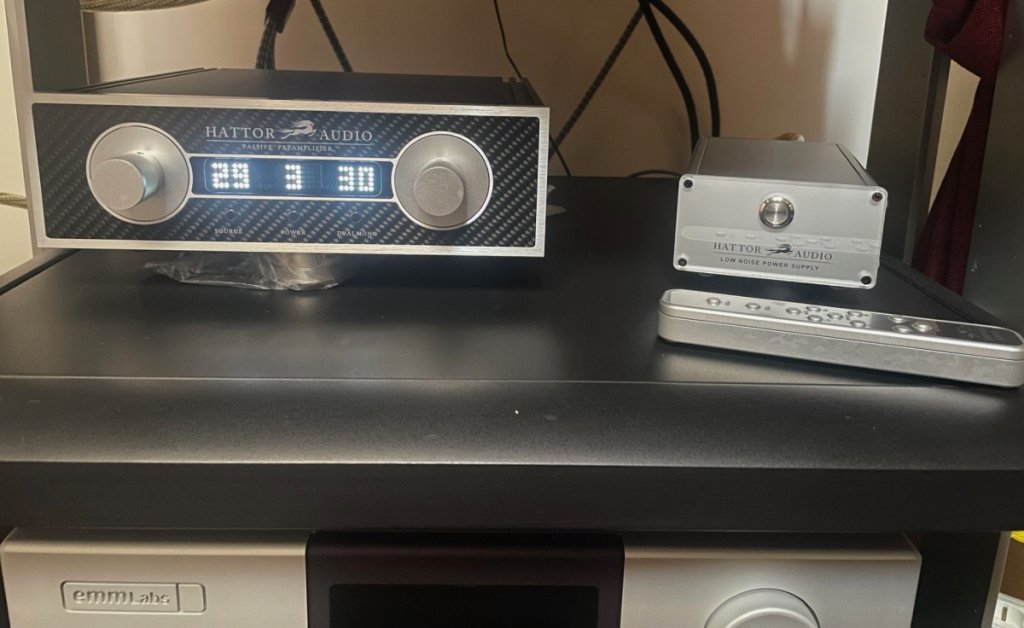
Following the interesting experience with the MFA Ref passive preamp, already in the audio system, very good, of a dear friend, the desire to experiment with something new pushed me to get a Hattor Audio, specifically the Takman Rex The Big Balance Passive Preamp model.
It has been running in my audio system since today, and the first impressions are positive! In a few days I will write more about the new arrival,
regards, Dario
Good morning, it's been a while, but I've had various commitments that have kept me away from here.
As an audiophile, every Hi-Fi component contributes its own value to the audio chain, especially the preamp, which for me is the heart, or brain, of the audio system.
This Hattor is an excellent machine, and I say this without reservation. After a reasonable amount of listening time, I'm very pleased with its contribution to the system's sound, with a few considerations...
First, a passive preamp can do very well in terms of timbre and detail, clarity, and lack of a musical signature. This Hattor Audio is no exception. It has all the positive attributes listed above, but it's different, as expected, from the Emm Labs Pre and even the previous MFA reference!
I'm writing this because, in my experience, in Hi-Fi, if you have a well-tuned and satisfying system, shortcuts can usually be disappointing and limiting when it comes to enjoying good sound.
Here we have a preamp with a very attractive quality-price ratio. In Italy, it retails for around €2,000. Compared to the MFA, which retails for around €11,000, and the EMM Labs, which retails for €30,000, it's a truly incomparable product!
Secondly, my system has been tried and tested for some time now, and with the right music, I can identify its pros and cons quite easily.
The Hattor passive preamp is less refined and a touch less natural in its presentation than the MFA passive preamp, which I can say is the best passive preamp I've used in years, for one quality that's truly important to me: the timbral realism and the sonic verisimilitude of the reproduced instruments, especially acoustic ones.
On the other hand, both the MFA and the Hattor lose something in terms of dynamics and sonic sculpting compared to the Emm Labs preamp. Above all, they have a more limited working range; at low volumes, they perform less well, while above a certain threshold, even at high volumes, they start to shriek a bit, something Emm Labs never does.
Thirdly, it seemed to me, but I need to check further, that the Hattor's sound is affected by a wire from the power cable used for its separate power supply, which controls the display and source switching. This shouldn't be true in a passive preamp, but it's a topic I don't know how to delve into. If anyone has any insights to contribute, they're welcome!
Fourthly, of a more practical nature, in my system a good passive amp manages to make me not miss the Emm Labs preamp. However, when I replace it, despite having a slightly less direct and neutral sound, it makes a significant contribution to the structure of the musical flow. It's hard to give up a preamp of such overall quality.
Last consideration, in Hi Fi quality is not proportional to the expense or the increase in the price list, and we have known this for some time now, there are objects that are decidedly very expensive, and perhaps I could include Emm Labs, there are others that are very favorable in terms of quality/price ratio, see the Hattor, there are very focused and even niche products, of great general value, see the MFA, to each his own budget and preferred sound, based on my thirty years of experience, I do not believe in giant killers, and a preamp costing a few hundred € or $ I believe would not integrate at a minimum adequate level in a well-tuned system.
One last note on sound: the human voice is a fundamental test, especially the female one, and passive preamps have that naturalness and clarity of emission that makes them so direct, emotional, and realistic, and here not even Emm Labs can do better!
Happy music to everyone!

