The AudioKinesis Zephrin 46 is now official!
Form follows function here... but it turned out to be a rather interesting form after all:
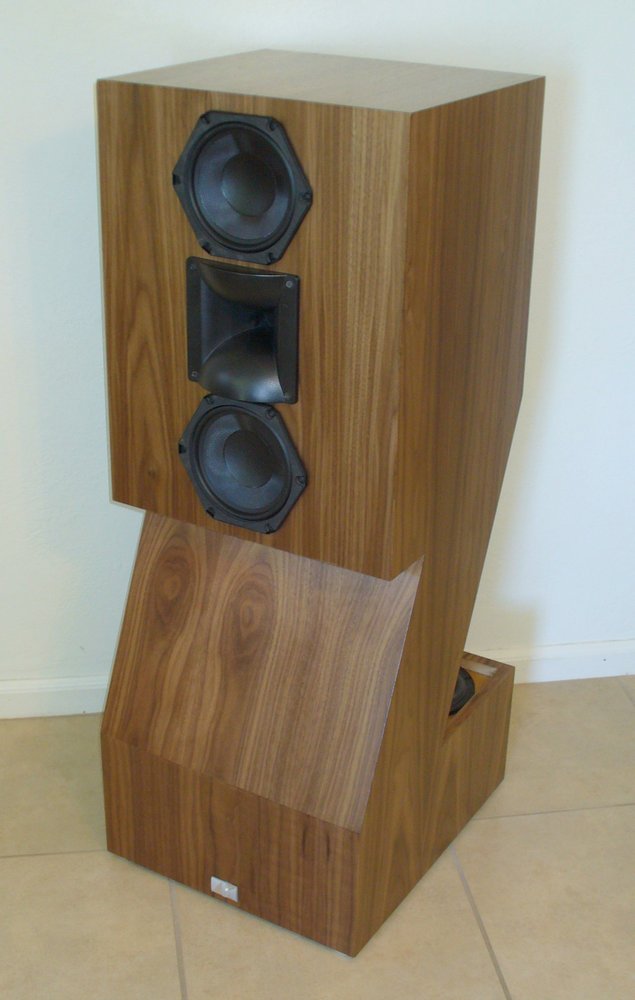
You can't really tell from the picture, but that's a milled aluminum "AK" logo at the bottom.
Okay for anyone not familiar with Jim Romeyn's Late Ceiling Splash (LCS) configuration, which is used here with his permission, the idea is to get a lot of spectrally-correct, relatively late-arriving reverberant energy into the room without the room-placement requirements of dipole, bipole, or omni speakers. The extra reverberant energy is fired from the floor up towards the ceiling, which gives us a nice long path-length-induced time delay. This improves timbre, spaciousness, and the sense of envelopment. The long delay preserves the imaging cues from the front-firing array, and then the ambience cues that are on the recording come from more realistic directions instead of primarily from the direction of the speakers (which is probably the worst possible direction). So we get imaging
and envelopment. Additional benefits include eliminating the baffle-step and mitigating the floor-bounce notch.
During the R&D path that resulted in the upfiring LCS configuration, Jim tried out variations on the bipolar theme, and found that the best results were from firing the secondary array up at the ceiling. This was counter-intuitive to me; I would have thought that having the reflections arrive from a more theoretically ideal angle would outweigh the longer time delay from the long bounce off the ceiling. So kudos to Jim for beating me at my own game, and my sincere thanks to him for letting me use his technology.
The original Dream Maker LCS system uses two boxes per channel, and correspondingly takes up a lot of real estate. The Zephrin 46 uses a to-the-best-of-my-knowledge unique geometry that shoe-horns the upfiring array into a reasonable-sized footprint. We do trade off some capability relative to the Dream Maker LCS system, but the price is a lot lower too.
What you see on the front there is two prosound 6" woofers that have very good thermal characteristics (high power handling combined with good efficiency), vertically flanking a small-radial-horn-loaded compression driver. That particular horn is a very gentle device, no abrupt discontinuities, so it has very low coloration. its pattern is not quite as uniform as we'd get from a true waveguide, but I haven't found a similarly small waveguide whose radiation pattern and smooth transition at the throat (critical for low coloration) are as good as this little horn. The radiation pattern
shapes don't quite match up in the crossover region, but the
net pattern coverages do, so there is no power response glitch in the crossover region.
Around back is the LCS array, which consists of four upfiring 1" soft dome tweeters and two upfiring 6" woofers... the total of four 6" woofers is where the number "46" comes from. This is a different 6" woofer, one better suited to its particular role (a bit less efficient, but with parameters better suited to take advantage of strong boundary reinforcement). The crossover for the upfiring array is tailored to its location within the room.
Each of the arrays is configured to present a 16-ohm load, and each has its own set of inputs. So the system can be configured as an 8-ohm load (both arrays in parallel) or as a 32-ohm load (both arrays in series). The impedance curves are smooth enough and similar enough that either configuration works. The 32-ohm configuration is primarily intended for compatibility with OTL amplifiers. I'm a big fan of Ralph Karsten's Atma-Sphere amps, and wanted to offer really good compatibility with his little S-30, which becomes a 50-watt amp into a 32-ohm load, with distortion reduced along the way. Most people will go with the 8-ohm configuration, which is still a benign enough load to work well with tube amps.
The Zephrin 46 is even more room-adaptable than my other designs, as both arrays have independent bass tuning adjustability and tweeter "tilt" adjustability. I haven't figured yet figured out what my recommendations will be for toe-in angle.
The Zephrin 46 will be making its debut in one of the Electra Fidelity rooms, 920, at T.H.E. Show Newport Beach in a little less than three weeks. Tony Chipelo of Electra Fidelity is a dealer for the Zephrin 46, as well as for the larger Dream Maker LCS system.
Finally, here are some preliminary specs:
Type: LCS (Late Ceiling Splash) system
Dimensions: 42" tall, footprint 16" wide by 18.5" deep; 80 pounds
Impedance: 8 or 32 ohms, user-selectable (tube-friendly in either configuration)
Efficiency: 92 dB/1 watt. Voltage sensitivity (relative to 2.83 volts input) is 92 dB in 8-ohm configuration, and 86 dB in 32-ohm configuration.
Power Handling: 400 watts RMS thermal, and estimated 200 watts mechanical (where the woofers start to go into over-excursion; this is of course program-dependent).
Typical in-room bandwidth: Upper 30's to 20 kHz
Price: $4900/pair
Ever since I showed my Jazz Modules in 2006, I've had dealers asking me if they could sell my speakers. Not every dealer that comes in the room of course, but enough (and some of these guys have considerably more experience than I do). I always turned them away, saying that my margins didn't have enough slack in them to begin to accommodate dealer markup. But I always hoped to one day have a design that had a high enough performance-to-build-cost ratio that it would be as competitive with dealer markup as the Jazz and its descendents were without it. Jim Romeyn's LCS technology gives me that opportunity - imo it adds enough enjoyment to the experience that, at $4500, the Zephrin 46 is even more competitive than the Jazz Modules were at that same price when they were introduced eight years ago. I want people to be able to hear these speakers, and that means I need to get them out there, and a time-honored way to do so is through a select dealer network. I don't want a whole bunch of dealers, only a few. I realize that going from direct sale to dealers is the exact opposite of the way the industry is moving these days, but dealers are the hardest-corest audiophiles of all, the most kindred spirits for a speakergeek like me, and I think Jim's LCS concept is too good for me try to keep it all to myself (not that I could... it's Jim's technology, not mine). So I think the time has come. I will continue of offer some of my more conventional models direct, but my best and brightest designs will be sold through dealers.

