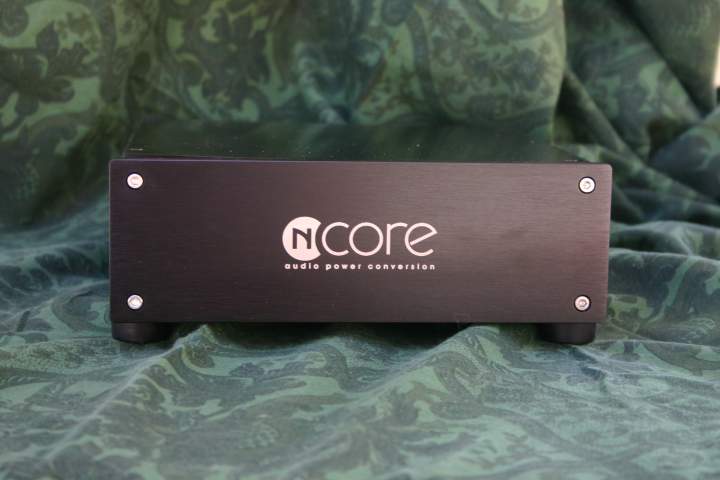

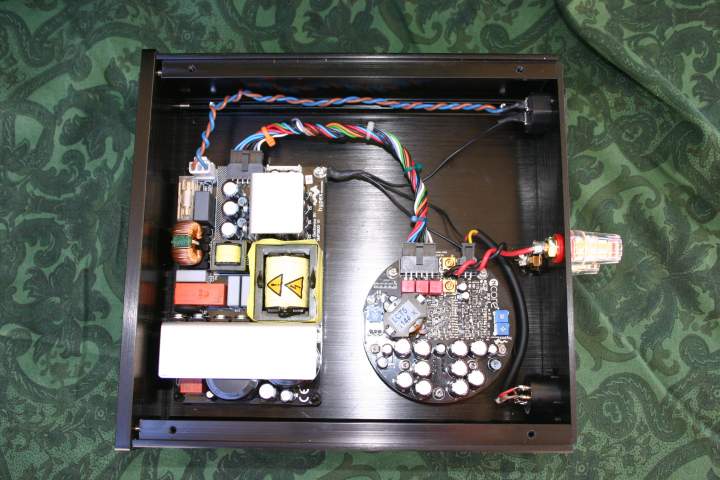
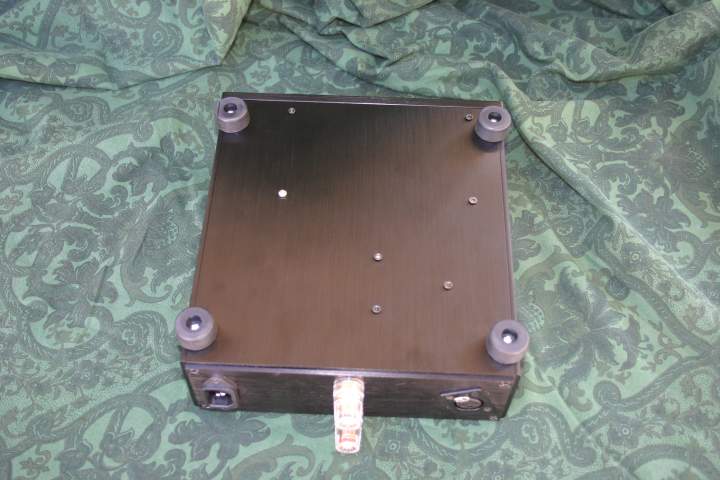
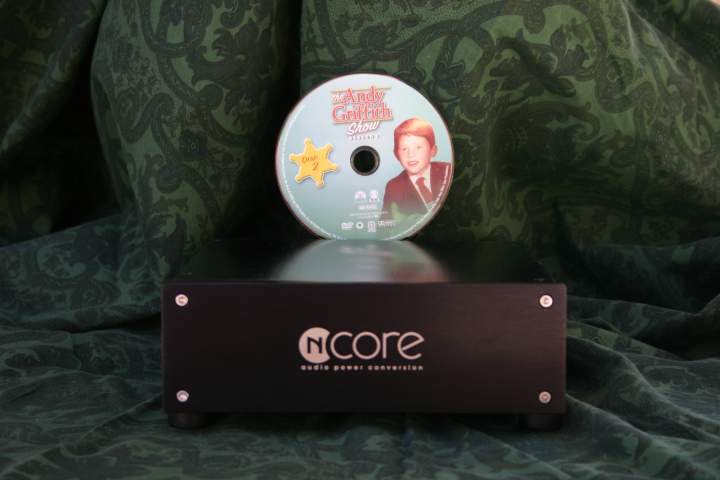
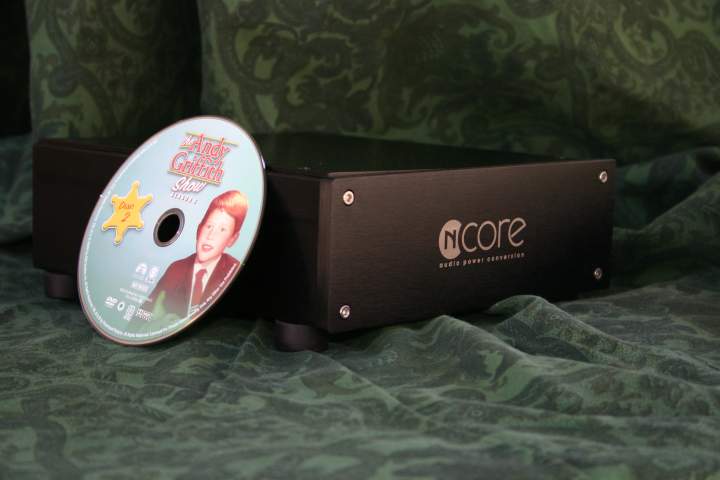
Yes, that is toe-headed Ron Howard, AKA "Opie Taylor". Disclaimer: not my DVD.
Only one built and functioning so far (installed in center channel of Trinaural Music system). I listened to only the center channel. Trinaural center channel output does not have the phase anomalies of summed mono L+R signal. So far so good.
Certified scale: 5lbs 1.9oz...amp board and ps board alone 1lb 3.9oz.
I'll post system details and more feedback after I finish all three amps/power cables/IC. First impressions after only a few hours of use. It's quite a bit different from the AKSA Naksa 100. Main speakers are high-pass crossed 2nd Order in-phase @ 80 Hz (Trinaural Processor...5-piece sub described
HERE). Each channel of my speaker system is two 8 Ohm stand mount monitors in
THIS unique array. Each channel can present either of the following two loads to the amp:
2.7 Ohm minimum @ 200 Hz, 4 Ohms flat above 600 Hz (parallel) OR
10.6 Ohm minimum @ 200 Hz, 16 Ohms flat above 600 Hz (series)
I presume the following is correct: Ncore maximum power is about 500Wrms into the former load, about 100Wrms into the latter load, with concomitant lower distortion and much lower current demands. Into the latter load, Ncore power limits at the higher 16 Ohm impedance, but has higher power potential (about 160W) @ the 200 Hz minimum, if the music program demands such only in that range.
Anyway, I listened to Telarc's well recorded Glinka: Ruslan And Ludmila Overture. First several times @ 16 Ohms/series, then 4 Ohms/parallel. As expected, there appeared to be a 6 dB gain difference and thank goodness my preamp has dB steps.
The difference was similar to every SS amp on which I performed this test. 16 Ohms sounded better by significant margin. With lesser amps the sound quality outweighed the power deficit. In this case, much better sound but with apparently unlimited SPL, yes, even @ 16 Ohms (each channel of my system, comprising two speakers, about 88 dB actual sensitivity).
4 Ohm (2.7 Ohm minimum) sound quality was, well, frankly, not very special. It was OK, nothing awful, just not inviting. I'm as surprised as anyone else. Switching to 16 Ohms (10.6 minimum) was a revelation. My best analogy is an extremely linear and transparent 400W tube amp. From the mid bass up through the lower mid range "sound density" was like a great, smooth horn system, but with superb transparency. IOW, it was thick as soup and transparent at the same time. Detail and layering was phenomenal. Differences between the string instrument ranges was superb. Ncore excelled in tonal variety, the same area in which Tyson said it was inferior to his lovely 70W tube mono blocks. Go figure.
So far I like it.
The Trinaural allows perfect integration (yes, I mean perfect, absolutely no negative impact with either format) of music/HT if/when a perforated screen/front projector is employed. I later put on Cream Live At Albert Hall. Even with only one Ncore amp (L/R channel power is circa 2003 YBA Audio Refinement with minor mods) I'm here to tell you this 100W Ncore/speaker interface might be mistaken for 400W. There is so much more presence in the mid bass range that I'm quite sure I'll need to re-adjust the sub xo. Oh well.
My best/closest comparison, with this admittedly very limited experience, is to an Ampzilla 2000 mono block Series II (200/400/800W @ 8/4/2 Ohms). IMO the Ampzilla would seem to handle lower impedance much better. You better get something for 65 lbs and almost $4k per channel! This is interesting, because both designers are hard core fanatics (maybe among the most fanatical) for low distortion figures. Several years ago at CES, Ampzilla and Trinaural designer James Bongiorno asked a Meridian engineer about their technical equipment. James chuckled, saying he stopped using that gear a long time prior. I'd love to hear a conversation between Bongiorno and Putzeys.

