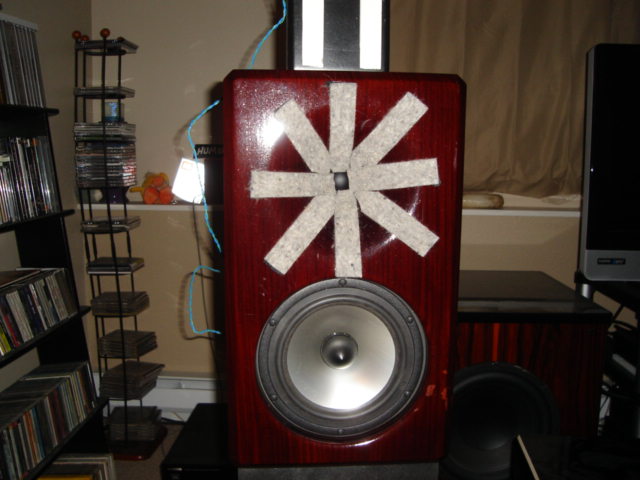
I contacted Jim the end of Oct.'08 to inquire if anyone with horn tweeters had used his product to try and dampen the HOM, high order modes, inherent in all horns. Dr. Earl Geddes had discovered these aberrations as a form of diffraction in his investigation and development of the oblate spheroid horns he uses in is designs. While the oblate spheroid minimizes these modes, it does not eliminate them completely, and Dr. Geddes utilizes an open cell, 30 ppi or pores per inch, foam plug in his horn to address them further. This method requires adjustment in the crossover to correct frequency shaping that the foam makes to the response of the driver. The Timepiece Minis I own use a proprietary variation of an oblate spheroid. As I did not have the option of cross over adjustment, I thought that I could take a stab at attenuating the HOMs using the wool felt that Jim uses to address the diffraction on flat baffles. Jim informed me that no one had used his product in this way before. After numerous emails discussing the various ways the felt could be used, we came up with a scheme of strips radiating out from the center of the horn, toward the edge of the baffle. Jim sent me 8 scrap strips to mount. It soon became clear that these strips were too thick and did not provide enough coverage to significantly affect the sound. I proceeded to split them in half, a tedious process indeed. But no more tedious than the process of attaching them to the baffles using the hook and pad Velcro stick-um thingies that are used in the diffraction be gone product. The effect was subtle at best. I decided to leave them in place as I knew in the coming months I would be making numerous changes, hopefully improvements, to my system. Better to let them become a part of the "system fabric" as it might be easier to judge their effect more accurately by their elimination once all the other beneficial changes to my system had occurred.
There was the Bryston BDA-1 comparison with the Van Alstine Insight DAC, and the addition of the AV123 X-Amps. I got new speaker stands, with granite tops. I tried sad balls, inert decoupling spheres, under the granite. These did not work. Brass cones and discs were much more preferable.
At this point I removed the wool strips. At first, there was not much difference, with just a little more treble energy present. Jazz and rock were little changed with the exception of the cymbals increasing in loudness seeming to move them closer to the front of the sound stage. I put on some jazz with a trumpet with mute as I've heard that the mute causes some really high overtones to be created. Apparently the overtones created were not on the recordings I used as I could not detect much change. Then I put on one of my favorite classical cuts, Tchaikovsky's Violin Concerto in D played by Leila Josefowicz and the Academy of St Martin in the Fields. As soon as the upper registers of the violin were presented, an edgy, grating overtone became evident. A sound I had mistakenly associated with digital hash would increase with volume and higher frequency. This was just as it was found by Dr. Geddes, that HOMs are more evident at higher SPLs, at increasing frequency. The overtones of the violin had excited the diffraction. As soon as I replaced the strips, the edge and hash diminished, replaced by the smooth, detailed presentation I had grown accustomed to after 3 months. To be sure, the strips are fugly, resembling giant spiders attacking my tweeters. As I could care less, and don't have anyone else around here to mollify, they're not going anywhere. They only affect the sound at higher SPLs at higher frequencies, but the effect is much more preferable with them, than without them. I suspect a more effective and aesthetically pleasing implementation could be devised by form fitting the wool completely to the horn. It would still obscure the wood finish. It is not clear if the foam that Dr. Geddes uses has more of a diffusion or diffraction effect. Perhaps there is a better material than the wool felt that would be both better looking and more effective in the diffraction/diffusion effect.
To review, and be completely clear, the wool strips, as I've used them, attenuate a certain hash present in higher frequencies but only on certain instruments and only at SPLs over 80 db.
I'd like to thank Jim for allowing me to experiment with his product to investigate its effect with my speakers.